
Copyright and teaching
Knowing when and how to use copyright material for teaching
The use of third-party copyright material for educational purposes is permitted through special statutory and voluntary education licences and exceptions within the Copyright Act 1968. Different licences and exceptions apply depending on how the material is being used and whether you are using:
- literary works (such as books, book chapters, journal articles)
- artistic works (such as images, photographs, figures)
- TV and radio broadcasts (including webcasts of broadcasts)
- multimedia (including PowerPoint presentations)
- video works (including DVDs and online streaming videos)
- music and sound recordings
Sharing learning material with students
Published learning material and readings - such as scanned book chapters, journal articles, ebooks and commercial video material (such as films and DVDs) - should only be accessed by students using OneSearch or through Unit Readings.
Do not provide access to copyright material by uploading it to other systems such as Dropbox, MS Teams, or sending it via email. Students should be reminded not to share copyrighted material with others beyond the LMS.
Entire copies of journal articles and other resources (like case law) from subscription databases, such as ProQuest or LexisNexis, cannot be shared directly as uploads to the LMS, nor can they be included in print unit/course readers. You must use Unit Readings to provide a copyright compliant link to the reading.
Print unit readers should only contain:
- Material that you have developed and own the copyright in (e.g. original lab manuals; lecture notes)
- Copyright-free, open access or openly licensed material (e.g. open access articles with Creative Commons Attribution CC-BY licences).
Please see the Copyright at UWA webpage for information on how to locate open access, openly licensed resources for teaching.
The Librarian Support Team can help you to locate or obtain course materials that can be shared with students via Unit Readings.
Licences
- Education licences
-
1. The statutory licence
Section 113P of the Copyright Act contains a statutory licence under which the University can copy and communicate works and broadcasts for educational purposes, subject to a number of conditions.
The statutory licence allows the University to copy and communicate works (except for computer programs) and television and radio broadcasts for educational purposes.
Copyright warning notice under the statutory licence
All material copied under the statutory licence and electronically shared with students must have a specific warning notice attached to it in such a way that the notice appears before or at the same time as the material being communicated appears on the screen. The notice must be located in such a way that the student using the material will see it – for example, at the beginning of a PowerPoint presentation (if the presentation contains images from the internet or other material copied in reliance on the statutory licence). The wording of the notice differs depending on whether you've copied text or broadcast material. The copyright warning notice is automatically added to all Echo360 recordings and relevant readings in Unit Readings.
Insubstantial portions of work such as quotations, and Creative Commons or Open Access works, do not require the warning notice.
There is no prescribed size for the notice but it must be legible. The wording of the notice cannot be changed. The copyright warning notice for copies of text works is as follows:
WARNING
This material has been reproduced and communicated to you by or on behalf of The University of Western Australia in accordance with section 113P of the Copyright Act 1968 (the Act).
The material in this communication may be subject to copyright under the Act. Any further reproduction or communication of this material by you may be the subject of copyright protection under the Act.
Do not remove this notice.
For more information on the wording of the notice for copies of broadcast (TV and radio) material, please see the downloadable guidelines as well as the "Broadcasts" section below.
UWA Copying and Communication Best Practice Guidelines 2020 [RTF 92KB]
UWA Copying and Communication Best Practice Guidelines 2020 [PDF 151KB]
2. Tertiary Music Licence
The University has entered into a voluntary music licence enabling staff and students to copy and communicate sound recordings for educational purposes, perform music at some University events, and play music on campus.
This was entered between Universities Australia, representing Australian universities, and four Australian music collecting societies:
- APRA AMCOS (the Australasian Performing Right Association and the Australasian Mechanical Copyright Owners Society formed an alliance in 1997)
- the Australian Recording Industry Association (ARIA);
- and the Phonographic Performance Company of Australia (PPCA).
More information is under "Tertiary Music Agreement" in the "Music and Sound recordings" section below.
Assisting persons with a disability
- Exceptions to assist people with disabilities
-
The Copyright Act includes two free exceptions that allow people and educational organisations to use copyright material to assist people with disabilities.
- Fair dealing for the purpose of access by a person with a disability
-
A person with a disability, or a person acting on their behalf, can copy and/or communicate copyright material, make changes to the format and add features if it is for the purpose of providing access to (creating an accessible version for) a person with a disability, and providing the dealing is fair.
When is the dealing fair?
The dealing must be ‘fair’ to avoid infringing copyright in the material. The provision requires the person dealing with the copyright material to take into account the following factors when determining if the dealing is ‘fair’:
- the purpose and character of the dealing
- the nature of the copyright material
- the effect of the dealing upon the potential market for, or value of, the material
- the amount and substantiality of the part dealt with, taken in relation to the whole material (if only part of the material is dealt with)
Important: The dealing may still be fair even if an entire work is used under this provision.
- Use of copyright material by organisations assisting persons with a disability
-
This exception allows organisations to use copyright material (such as making accessible format copies and adding features to them) for the sole purpose of assisting a person with a disability to access the material in a required format if the material is not commercially available in that format. This replaces the provisions in the old educational statutory licence (previously Part VB of the Copyright Act, repealed in 2017). This exception could be used to provide support to students about to start a unit of study, academics or Higher Degree by Research students.
Covered organisations
The exception covers educational institutions, such as the University, and not-for-profit organisations with a principal function of providing assistance to persons with a disability (whether or not the organisation has other principal functions).
Commercial availability
Organisations are required to purchase an accessible copy if it is commercially available in a format suitable for assisting the person with their disability. The copyright material will not be commercially available if a suitable format copy cannot be obtained within a reasonable time at an ordinary commercial price.
Permissible format changes
The provisions are designed to be flexible to ensure copyright material can be converted into the best format available and with appropriate features.
A person can make any changes to the format and add features which help a person with a disability enjoy the material; for example, scanning a book for use with assistive technology, making adjustments to the size and colour of graphs, tables or text, converting books into easy English, and providing audio descriptions.
Definition of person with a disability
A person with a disability is anyone who suffers from a disability that causes them difficulty in reading, viewing, hearing or comprehending copyright material in a particular form. In practice, this includes anyone with a disability as defined in the federal Disability Discrimination Act 1992.
For more information on disability support services at UWA, contact the UniAccess team.
Text works
Different copyright limits apply depending on the original material type – a print book, an ebook or a website. Before including copyright material in your PowerPoint presentations, or uploading copyright material to your LMS unit, check the copyright compliance guidelines for the LMS (at the bottom of this page).
- Print books and journal articles
-
Under the statutory licence, the University can copy and communicate a certain portion of text (including sheet music) and artistic works for educational purposes without having to seek permission from the copyright holder, providing copying limits and attribution requirements are met.
All scanned extracts of books, journal and newspaper articles must be made available through Unit Readings to ensure copyright compliance across the University.
Under the statutory licence, the University can copy:
- 10 per cent of a book or one chapter, whichever is greater
- one article from an issue of the journal, or more than one article if the subject matter of the articles is the same.
The statutory licence also allows for extracts of anthologies, dramatic works (such as plays or screenplays) and musical works to be copied and shared through Unit Readings:
- an entire work from an anthology (an individual poem, short story or conference paper) providing that it is less than 15 pages. If the work is more than 15 pages, a reasonable portion can be copied (10% or 1 chapter, if the work contains chapters). If the work exceeds 15 pages but has not been separately published, it can be copied in full.
- up to 10 per cent of the pages from a written play or screenplay
- up to 10 per cent of a musical work (sheet music); this is often counted as 10 per cent of the bars
Using Unit Readings ensures all digitised extracts are copyright-compliant and contain the required copyright notices.
- Ebooks and online articles
-
Online resources subscribed to by the Library, such as ebooks and journals, may impose their own limitations on how the resource can be copied and shared for teaching purposes. These limitations override the statutory licence copyright allowances. Do not copy from these resources without first consulting with the Library.
Rather than copying from online subscription resources, provide OneSearch links to the resources through Unit Readings.
- Quotes and short extracts
-
Copyright will generally not be infringed if an insubstantial portion of the copyright material is used. A portion will be considered ‘substantial’ if it is a key, distinct, important or essential part of the copyright material. It will depend on the circumstances of each case whether a portion is so important that permission is required to use it. Consideration needs to be given to the importance the portion bears to the copyright material as a whole.
The quality of the portion is just as important as the quantity used from the copyright material. The portion may be substantial even if it is a small proportion of all of the copyright material.
The insubstantial portion rule does not apply to sheet music or artistic works/images.
- Text from websites
-
Just because something is made freely available online does not mean it is not protected by copyright!
Where possible provide links to websites, rather than downloading or copying across website content. That said, you should never link to an infringing website (a website that hosts infringing materials that have been shared without the copyright owners' permission, like file-sharing or peer-to-peer sites).
Before copying material from any online source, check the site for a statement which defines how material on the site may be used. You should abide by this statement as with any licence. If the site contains no permitted use statement or only contains a basic copyright statement, then you may copy 10 per cent of the words from the website under the statutory licence. If it's not possible to determine 10 per cent of the words, ensure that you only use what you need for educational purposes.
- Your own published work
-
If you own the entire copyright for a piece of work, copying limitations do not apply and you may copy as much as you require.
If you share copyright with another person or company, or if you have published an article in a journal and transferred copyright to the publisher, you should seek their permission in writing or rely on the statutory licence copying limits (only copy one chapter or 10 per cent of the work) to make the work available through Unit Readings.
If you're not sure who owns the copyright in your published work, check your publication agreement or contact the publisher for clarification.
- Out-of-print or unavailable works
-
More than 10 per cent or one chapter can only be copied if the University is satisfied, after reasonable investigation, that copies (other than secondhand copies) of the work cannot be obtained in a reasonable time (generally considered to be six months for textbooks or 30 days for other works) at an ordinary commercial price. Contact the Librarian Support Team to determine if a work is out-of-print.
Artistic works
An artistic work may be an image, photo, drawing, graph, table, or figure.
- Images from print sources
-
- If, in the pages you are copying, you copy an artistic work which is included for the purpose of illustrating the text (such as a photo within a chapter of a book) then you may copy all of the artistic work.
- If you wish to copy only the artistic work and exclude the text, and the artistic work has not been published separately, you may copy all of it. You can copy as many images from the work as you require provided that they have not been separately published.
- If the artistic work has been published separately but cannot be obtained for a reasonable price within a reasonable timeframe, you may copy all of it - but contact the Librarian Support Team before proceeding.
The statutory licence copyright warning notice [available in the education licences section at the top of this page] must accompany images that are shared with students in a PowerPoint presentation, through the LMS or via email, and the image should be referenced.
Note that the insubstantial portion allowance [outlined in 'Quotes and short extracts' in the Text works section] does not apply to artistic works, as it is not possible to copy (or even define) an ‘insubstantial portion’ of an image.
- Images from online sources
-
Under the statutory licence, if an artistic work is copied from an electronic source such as a website, then you do not need to check whether it has been separately published. In most cases, however, such images are subject to a licence or contractual agreement (terms of use or a ‘click through’ agreement). If licence or contractual terms exist, you must abide by those terms.
If an image has been accessed via a Library subscription resource (such as a journal article from a database) or Creative Commons licence, you must abide by the terms of the licence.
The statutory licence copyright warning notice must accompany images that are copied under the statutory licence and shared with students in a PowerPoint presentation, through the LMS or via email, and the image should be referenced.
For more information about using images from licensed resources, or for assistance with finding Creative Commons images, contact the Librarian Support Team.
Multimedia and presentations
- Presentations
-
Generally when you share a PowerPoint (or similar) presentation with students, this will be part of a lecture automatically recorded in the Lecture Capture System, EchoVideo. This automatically adds the copyright statement slide at the start of the recording.
Where you are sharing presentation slides with students in the Learning Management System, but they are not being recorded using EchoVideo, please manually add the copyright and indigenous acknowledgement slide at the start. You can download these from:
Attributing material in a presentation
All material that is not your own creation in a presentation, including images, must be attributed correctly to the copyright owner in the presentation itself, not as accompanying text elsewhere.
ATTRIBUTION INFORMATION TO PROVIDE
For Creative Commons items, check how the creator specified that you attribute their work. Otherwise, ensure you include the creator name, and a link to where the material was accessed if possible. Formatting like a reference in whichever style you use is usually sufficient.
WHERE TO ADD ATTRIBUTION
You can add attribution either:
- visible in the footer of each slide
- in a list of sources at the end of the presentation
If you add a list at the end, ensure the viewer can match the attribution to the image. Just a list of creators and works is not sufficient. You can, for example, add the slide number. If you have a lot of images on a single slide, you should make it clear which reference matches which image.
Broadcasts
- Broadcasts (including webcasts of broadcasts)
-
Staff can copy and communicate broadcast radio and television programs for educational purposes under the statutory licence.
The statutory licence covers the following broadcasts:
-
any TV or radio broadcast from free-to-air and pay TV channels, and AM and FM radio channels
-
podcasts/webcasts by the broadcaster of programs previously broadcast on their free-to-air channel
The statutory licence does not cover:
-
webcasts of programs previously broadcast on a pay TV channel (Foxtel) or delivered via a webcast service such as Netflix
-
non-broadcast video sources such as DVDs or Blu-rays
-
web video sources such as YouTube or Vimeo
-
pirated or infringing copies of broadcast content
More information on using DVDs and streaming videos in teaching is available in the "Video works" section below.
If you comply with the required procedures 1 – 3 below, the copied work can be used during lectures, or embedded in PowerPoint presentations and LMS units, or sent to students via email.
There are no limits on the type of material that can be copied from television and radio under the statutory licence (advertising, documentaries, episodic dramas, feature length movies etc) and you can copy all or part of the material. You are also entitled to make as many duplicate copies as needed of any work you are copying under the statutory licence.
The requirements are:
1. Physical copies are labelled
All statutory licensed copies of broadcasts in analogue form, or on removable media (e.g. DVD, CD, USB), must contain a notice with the following information:Program Name: ____________________
Broadcast Date: ____________________
Broadcast Channel: _____________________
This program has been copied under the Statutory Licence pursuant to s113P of the Copyright Act 1968 for the educational purposes of the University.
This notice should be attached to the container in which the copy is kept (e.g. DVD/CD case).
2. Procedures for sharing material digitally are followed
You can place audiovisual material copied under the statutory licence online for students to access, or send it to students via email, so long as the copyright warning notice shown below is displayed in such a way that the viewer will see the notice at some point during their “access journey”. Broadcast material shared online must be made available only to valid UWA staff members or students.
This program has been communicated under the Statutory Licence pursuant to s113P of the Copyright Act 1968 for the educational purposes of the University.
3. The original source is cited
Not only is it good academic practice to cite your work, it is also essential for copyright compliance. A citation should include the following information:
-
Title of program
-
Time of original broadcast
-
Date of original broadcast
-
Duration (in minutes)
-
Whether sourced from TV, satellite, cable, or radio
-
Name of the TV channel or radio station
-
Video works
- DVDs
-
You may play purchased audiovisual material (e.g. DVDs) live in class providing:
- it is in the course of educational instruction (that is, not for entertainment)
- all of the people in the audience are giving or receiving instruction or are directly connected with the University
It is also possible to play hired or rented audiovisual material for educational purposes, providing you were not advised not to at the time of hiring the material.
If you are recording the lecture using the Lecture Capture System (Echo360), you can edit out the part of the recording that contains the movie/DVD footage following these instructions.
In some circumstances, Section 200AB of the Copyright Act might cover the reproduction of a DVD or video, but this exception applies on a case-by-case basis. Contact the Librarian Support Team for more information.
- Using YouTube videos
-
It is preferable to give your students a link to the YouTube video, or embed the video into your LMS unit. However, you should avoid linking to or embedding videos where you suspect the material infringes copyright (i.e. the video was not created by the person who uploaded it to YouTube).
YouTube’s terms of service don’t allow for videos to be copied, and capturing a YouTube video in the LCS is essentially the same as making a copy of the video. To avoid making a copy of the video, you can edit out the part of the recording that contains the YouTube footage following these instructions.
In some circumstances, Section 200AB of the Copyright Act might cover the reproduction of part of a YouTube video, but this exception applies on a case-by-case basis. Contact the Librarian Support Team for more information.
- Creating and uploading your own videos
-
Uploading to Echo360
Video content you create should usually be uploaded and shared via the Lecture Capture System - Echo360. All content uploaded to Echo360 has a copyright notice, and a message of indigenous recognition, added at the start of the video. This includes recordings of scheduled lectures and recordings made using applications like Universal Capture.
Movies uploaded to Echo360 and shared only in the Learning Management System must correctly attribute any material created by another author.
See the "Music and sound recordings" section below for information about synchronising audio as part of a video in the LMS.
Uploading to YouTube
If you want to use images, music or any other media sources in videos that you upload to YouTube, you must either own the copyright or use sources that are copyright free or openly licensed. This applies to images and photos that you've found on the internet – always check the website's terms of use before using an image in a video that you’ve created and uploaded to YouTube.
If you do use appropriately licensed third-party content in your video, ensure you provide a full citation to the original source.
Tip! Use sites such as Creative Commons to find openly licensed images.
- Streaming services like Netflix, Stan, Amazon Prime
-
The statutory licence does not cover material from video streaming services such Stan, Netflix, Presto and Quickflix. Material from these services cannot be played in class, shared through LMS or captured through LCS. Their licences are only for personal and domestic use, and are not covered by copyright exceptions for research or study. The exception to this are some "educational documentaries" available through Netflix that are available for one-time educational screenings. For more information, see the educational screenings of Netflix documentaries webpage
If you wish to use a title from a streaming service, you can suggest that students privately watch movies using their own accounts, providing they have access to an account. Keep in mind that not all students may have access to a particular streaming service.
You can search these two sites to find out which service currently streams a particular movie:
- Freeview - free-to-air television stations' "catch up" services
- Just Watch - commercial streaming services like Netflix, Stan, Amazon Prime. Also includes most free-to-air catch up services.
Material available from services such as Freeview and iView may be covered under the statutory licence providing the material is identical to that already broadcast on TV, and providing it is available for download. If it is only available in streaming mode, using software to capture the material will infringe copyright.
- Screening a film for non-educational purposes
-
Screening a film at an event – like a movie night – is considered to be a 'public performance' and so requires permission from the copyright owners, regardless of whether an entry or attendance fee is charged.
The Australian Copyright Council has produced an information sheet on screening films in public which outlines the reasons why permission is needed, and the organisations to contact in order to obtain permission.
Alternatively, the film that you are wanting to screen – or a similar film – may be available through the online platform, Kanopy, that the Library subscribes to. You can show a Kanopy film provided you are an enrolled UWA student or staff member and you:
- stream it live (so don't try to download or record it) on the UWA campus (so you can't hold the event off-campus)
- don't charge a fee for admission
For more information about Kanopy movies, contact the Librarian Support Team.
Music and sound recordings
- The Tertiary Music Licence
-
What the licence covers
The Tertiary music licence is an agreement between the Australian universities represented by Universities Australia, and APRA AMCOS, ARIA and PPCA. The licence covers copying print music and scores held in the UWA collection, as well as using music for teaching, performing live music, and reproducing and playing sound recordings.
The music licence broadly includes the following rights, with some further conditions and restrictions:
- copying music or sound recordings for educational purposes
- performing music in public at University-run events where there is free admission or a ticket-price of $60 (+GST) or less
- synchronising music to video footage to create audio visual works for university purposes, with some restrictions on further sharing
- playing background or featured music at graduation ceremonies
- playing background music in the workplace
- playing music on hold
Any performance or reproduction of music must be made from legitimate sources.
Different teaching and learning uses are outlined in the menu items below. For more information on the non-teaching music uses allowed under the licence, or to discuss whether a proposed use fits within the terms of the licence, please email the Senior Librarian (Copyright) at [email protected].
- Music for teaching
-
The music licence allows for sound recordings to be used for educational purposes, providing access is restricted to UWA staff and students and the music has been obtained from a legitimate source (i.e. not illegally downloaded). The licence also allows for the performance of live music for educational purposes and at University events.
"Educational purposes" needs to involve actions necessary for delivery of a course, like assessment or teaching. It does not include commercial activities, advertising and recruitment. Under the licence recorded music can be used for "University purposes", such as promoting student work or UWA research, but not if it is primarily for advertising or recruitment.
When you use recorded commercial music, you are using the work of two sets of music creators: the people who created the lyrics and music, and the performance by the artist. The music licence covers all of these uses by most recording artists published in Australia. You can check whether music you want to use is covered by looking at the APRA AMCOS song catalogue, the PPCA list of current licensors and the ARIA list of copyright owners.
For educational purposes such as teaching, you may:
- play a sound recording live in class or during an online lecture
- capture a sound recording as part of a LCS recording
- upload sound recordings to Unit Readings
- perform live music (e.g. as part of a student recital or a free lunchtime concert).
There are restrictions on the types of musical performances that can be used - see Uses not covered by the music licence for more information.
Sharing assessments that use sound recordings beyond the LMS
If you or your students use licensed music for an assessment submitted via the LMS, the work cannot be shared via social media, for example by uploading it to YouTube or Facebook.
If you want to share a music recording publicly; for example, creating a remix of songs, or as a soundtrack to an animation, or as background music to a podcast, you may want to investigate using music released under a Creative Commons licence. A good starting point for finding music that you can remix and share is the list of sites on the Creative Commons Legal Music for Videos page.
- Playing or performing music
-
In addition to educational purposes, playing sound recordings or performing live music is permitted:
- as background or featured music at a University event* where admission is free, or the ticket price is under $60 (+GST)
- as background or featured music at graduation ceremonies (regardless of the ticket price)
- as on-hold music
- for University staff to listen to in staff work spaces and at staff parties.
*A University event is any event organised and authorised by the University, excluding events that are managed or promoted by a third party. It can be held on or off-campus and open to the public or just the university community. This includes open days, seminars, lectures, and exhibition openings.
- Copying print music
-
From 2025, the University’s music licence also includes the right to reproduce print music (i.e. sheet music and scores), providing:
- the copying is done for UWA staff and students only
- copies are made from original scores that are owned by the University
- the number of copies made does not exceed the number of staff and students who need access to a copy
- digital copies are stored in Unit Readings, for access by UWA staff and students only
- copies are destroyed or permanently deleted when they are no longer required for the purpose for which they were made.
Copies of print music may be made for educational purposes, or for performance purposes at a University event.
All hard copies must be marked, and digital copies must be labelled, with the following:
“Copy made pursuant to a licence between Universities Australia and AMCOS”
Title of work;
Composer;
Lyricist; and
Arranger name (if applicable).
The print music licence does not include the right to:
- make copies of Grand Right Works, or of choral works of more than 20 minutes’ duration
- make copies from scores that are not owned by the University (i.e. we cannot copy scores that are borrowed or hired)
- make arrangements of, or any alterations to, the work or the lyrics contained in the work
- sell, hire or otherwise make available copies made in reliance on the print music licence.
- Music in videos
-
The music licence differentiates between videos that capture music in-context, where the music was captured in conjunction with the video footage (e.g. recording a live performance of an event), and videos that have music added post-production, where the music was added to the video footage separately (e.g. adding background music to a visual presentation).
Where videos contain music (both live music being performed and sound recordings being played) that was captured in-context, you may share them on:
- the University website, which includes any official UWA webpage (hosted on uwa.edu.au)
- UWA social media channels, managed by UWA
- password-protected UWA platforms such as LMS, LCS and Unit Readings.
When commercial sound recordings are added to videos post-production, you may share the videos on:
- the University website, which includes any official UWA webpage (hosted on uwa.edu.au)
- password-protected UWA platforms such as LMS, LCS and Unit Readings.
In addition to the above, when live music is recorded and added to videos in post-production, you may also share these videos to UWA social media channels managed by UWA.
The purpose of sharing these videos must be for “University purposes”, i.e. activities undertaken by the University as part of its usual business. This excludes commercial activities such as commercial research, advertising, recruitment, and promotion of UWA or any third-party product or service.
- Uses not covered by the music licence
-
The music licence does not cover the following:
- box office (ticketed) events where the ticket price is over $60 (+GST)
- occasions when University premises are hired to students, student groups (including the Guild) or other individuals, or external organisations
- music use by student-run groups (the Guild, student clubs or societies), student unions and on-campus shops, cafes, restaurants and bars.
Those responsible for these activities will need to arrange their own music licensing. If you intend to hold an event where tickets will be over $60, contact OneMusic Australia to arrange an additional licence.
Types of music performances excluded from the music licence
The music licence does not include performances of the following types of music:
- ‘Grand Right Works’ – a show where the lyrics and music are written expressly for it, including large scale choral works of more than 20 minutes’ duration, operas, operettas, musical plays, ballets, revues and pantomimes
- music performed in a 'Dramatic Context' (using dramatic elements such as costumes, sets and dancing)
- arrangements of music or lyric changes
- music used in films that are screened to the public
If you are arranging for a third party to use a University venue and copyright material will be performed at the venue, confirm the third party has obtained permission to perform the material and the correct licences are in place.
Learning Management System
- Copyright compliance guidelines for the Learning Management System (LMS)
-
The guide below outlines the key points to observe when you add learning material to a unit in the LMS. You can download a PDF or RTF of the guide to Sharing Learning Material in the LMS for Unit Coordinators.
- Sharing Learning Material in the LMS for Unit Coordinators [PDF 236KB]
- Sharing Learning Material in the LMS for Unit Coordinators [RTF 306KB]
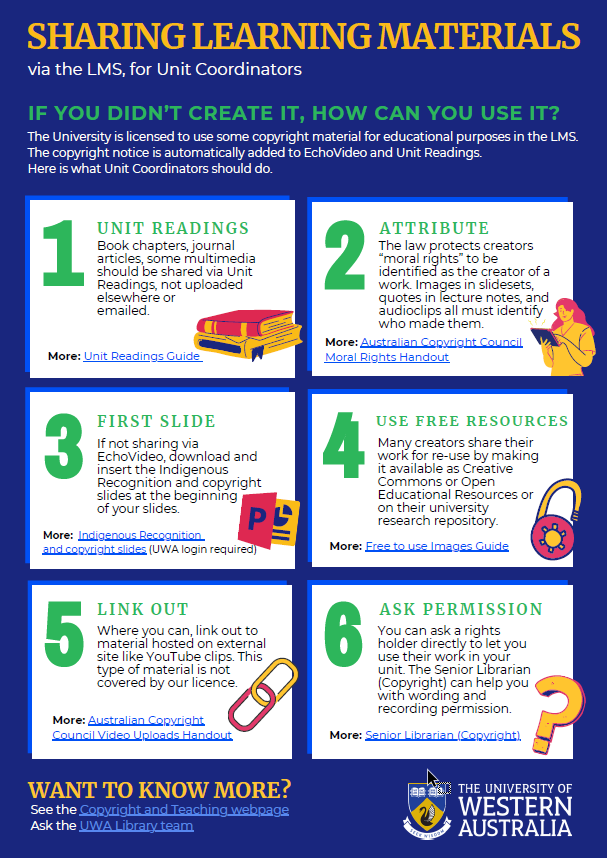
The more detailed guidelines below list the copyright checks to consider before adding material to the LMS. All reading material must be added to Unit Readings, not directly uploaded to the LMS. Access to published material – such as book chapters and journal articles – needs to be mediated by the Library to ensure copyright compliance across the University. Only upload files to the LMS if:
- you own the copyright in the material
- the material is openly licensed (more information can be found in the 'Free to use resources' section on the Copyright at UWA webpage)
- the material is out of copyright or copyright-free
All third-party material used in your unit, including text extracts, videos, images and website content, must be attributed so students can clearly see the source of the material.
More detailed information about the copying limits can be found in other sections on this page.
If you wish to use a material type not included in the below list, contact the Librarian Support Team for guidance.
Information in these guidelines has been adapted with the permission of the Curtin University Library Copyright team.
- Compliance checklist
-
Type of material Compliance checklist Images
Have you:
- Referenced the source of the image?
- Followed the terms and conditions of use, if the image is from a website that required you to accept an agreement prior to accessing/downloading the image?
- Attached the electronic warning notice? (Note that the warning notice is not required for Creative Commons or other licensed images.)
You cannot copy images that:
- Have been separately published and are still available to purchase
- Have never been made available to the public (such as student work) unless you have the written permission from the copyright owner.
Licensed or subscription material
Online resources subscribed to by the Library, such as ebooks and journals, may impose their own limitations on how the resource can be copied and shared for teaching purposes. Most uses relating to academic research or study are permitted.
Have you:
- Used Unit Readings to make library subscription material available to students?
- For other licensed material, have you followed the terms and conditions of the licence?
Music
If you’ve copied music in reliance on the Music Licence, have you:
- Attributed the source and attached the required warning notice? Ensure you obtain permission to use all other music files.
Open Access or Creative Commons
Have you:
- Fully and correctly attributed the source, and included a link to the licence information (if required)?
- Complied with the licence terms for Creative Commons material?
PDFs or documents
- Wherever possible provide links to websites, rather than download or copy across website content.
- Before copying material from any online source, check the site for a statement which defines how material on the site may be used. You should abide by this statement as with any licence.
- Ensure the material is attributed through a full reference
Published book chapters and journal articles should be made available through Unit Readings, even if they are accessible via OneSearch. PDFs from OneSearch should not be uploaded to the LMS.
Presentation slides
Have you:
- Fully and correctly attributed all images, text excerpts, websites, etc?
If you’ve copied images or extracts in reliance on the statutory licence, have you included an electronic warning notice at the beginning of the presentation?
Social media
- Where possible you should avoid taking screenshots of social media content, and instead provide a link or direct students to access it themselves.
- Do not share UWA teaching material or published material (such as journal articles and ebooks) on social media platforms.
- If the social media platform allows you to embed or share the content, then that should be used to do so.
Software
- Have you:
- Checked the terms and conditions of the software licence agreement to ensure you are permitted to share it
If the software licence allows sharing, ensure you provide a link to the licence agreement for students to access.
Text books
- Have you:
- Used Unit Readings to make your readings available to students?
If you have permission from the copyright owner to share the material, have you followed their terms of use, and ensured the material is fully and correctly attributed?
Videos
YouTube and online videos:
- Provide students with a link to the video, or use YouTube’s embedding/sharing functionality to embed the video within your LMS unit.
- Ensure the video is an authorised copy – check the uploader details to ensure they are the legitimate copyright holder.
Commercial DVDs and videos:
- Is the video from a Library video streaming database such as Kanopy or Informit TVNews? If so, it’s okay to embed the video within your LMS unit.
- You will need the permission of the film distributor to copy and share commercial DVDs.
TV broadcasts:
- Does the recording contain the electronic warning notice, and has the source been attributed?
Information on this page has been adapted with permission from the University of Sydney. This information is provided as general information only and is not intended to be comprehensive.
Stay in touch
Contact us to receive help and support from our friendly, knowledgeable staff.