

UWA PLUS
Diabetes Fundamentals [PHCYM501] and
Diabetes Education [PHCYN502]
Diabetes is a National Health Priority Area. The condition is characterised by hyperglycaemia caused by an inability to either make and/or use insulin effectively. Hyperglycaemia affect nearly every part of the body including diabetes-related retinopathy, neuropathies, poor wound healing and incontinence to causing chronic kidney disease, amputations and cardiovascular disease.
The first step to becoming a Diabetes Educator is to complete 24 credit points in a course accredited by the Australian Diabetes Educators Association (ADEA). We have two 12 credit point micro-credentials Diabetes Fundamentals and Diabetes Education designed for allied health professionals.
Diabetes Fundamentals [PHCYM501]
This micro-credential yields equivalent credit to completing two x 6 credit point units, namely PHCY5165 Diabetes Fundamentals 1 and PHCY5166 Diabetes Fundamentals 2.
This micro-credential provides you the opportunity to demonstrate your existing knowledge through assessed content. The content of this micro-credential includes all curriculum content required in the entry level qualification as a diabetes educator as it acknowledges that current practising allied health professionals will have existing knowledge in diabetes, patient education and counselling, critical appraisal skills and evidence-based practice, management and administration, and leadership and advocacy.
Diabetes Education [PHCYN502]
This micro-credential yields equivalent credit to completing two x 6 credit point units, namely PHCY5163 Diabetes Education 1 and PHCY5164 Diabetes Education 2.
In this, allied health professionals including pharmacists, will improve their ability to provide care to people living with diabetes. Topics covered will specifically focus on clinical practice to apply knowledge of best practice treatment, management and care to people living with diabetes. You will learn more about the role of the interdisciplinary team, and tailor clinical interventions to the individual to maximise the health outcomes for people living with diabetes. In doing so, you will learn to apply evidence-based education and self-management skills, interventions and techniques to support people with diabetes.
PHCYM501 and PHCYN502, if successfully completed, will lead to a Graduate Certificate in Diabetes Management and Education at UWA*. UWA's Graduate Certificate in Diabetes Management and Education is accredited by the Australian Diabetes Educators Association (ADEA) to meet Step 1 of becoming a Credentialed Diabetes Educator (CDE).
PHCYN502 Diabetes Education is delivered with the support of the Australian Government's Micro-credentials Pilot in Higher Education.
Upon successful completion of both micro-credentials PHCYM501 and PHCYN502, you'll receive:
- 24 PD Points (12pt for each micro-credential) - can be used for academic credit
- A Certificate of Achievement
- A UWA Plus Professional Development Transcript, listing all successfully completed micro-credentials
*In order to apply for the Graduate Certificate award you must have a relevant Bachelor's degree, or an equivalent qualification, as recognised by UWA: and be practising as a registered health professional with the relevant professional organisation. Please refer to the Graduate Certificate in Diabetes Management and Education.
For more information about this course contact [email protected] .
- Delivery mode
- Both PHCYM501 and PHCYN502 are Online.
- Prior to undertaking the assessments for PHCYM501 Diabetes Fundamentals, you should reflect on your own learning needs for understanding diabetes. You may choose to access the online curated resources for guided self-directed learning to develop your knowledge of diabetes. Alternatively, you may choose to undertake the online assessment tasks directly.
- Led by industry leaders, PHCYN502 Diabetes Education is a highly practical micro-credential that gives you the opportunity to develop your skills in providing care to people living with diabetes. This micro-credential will be delivered asynchronously online giving you the opportunity to study around your other commitments.
- Course dates PHCYM501 Diabetes Fundamentals
- 9 February 2026 - 27 February 2026
Registrations are now closed
- Course dates PHCYN502 Diabetes Education 2 March 2026 - 22 May 2026
Registrations are now closed
- Commitment
- Diabetes Fundamentals is an assessment of existing knowledge with personal study using self-guided learning, curated resources within a period of 2 weeks.
- Diabetes Education takes place over 12 weeks with online readings, video lectures, tutorials, simulated placements, assessments, and an optional in-person workshop on Friday 17 April and Saturday 18 April 2026.
All students must undertake a 40 hour placements. These are held in our telehealth student clinic. Students must book all 5 days in the first week of the micro-credential. Any students who do not satisfactorily complete any booked placement day will be required to pay $150 for each additional day required.
- Academic lead
- Dr Amy Page, Pharmaceutical Society of Australia's Pharmacist of the Year 2024
- Cost
- Currently only $990 inc. GST for eligible domestic participants to undertake both 12pt micro-credentials, PHCYM501 and PHCYN502. Thanks to the Australian Government's Microcredentials Pilot in Higher Education we are able to waive the fee for PHCYN502 for a limited time (limited fee-free places available).
Critical Information Summary
Diabetes Fundamentals PHCYM501 (PDF 253KB)
Diabetes Education PHCYN502 (PDF 244KB)

What you'll learn
Participants will be able to:
Demonstrate knowledge of the aetiology, pathophysiology, prevention, risk factor screening and management of long-term complications of diabetes.
Identify the precipitating factors that may contribute to the occurrence of acute complications.
Identify the relationship between diet and physical activity and how they can affect blood glucose management.
Demonstrate an understanding of the cultural, economic and social background and life stage that impact on a person's ability to self-manage their diabetes.
Demonstrate knowledge and understanding of the National Diabetes Support Service (NDSS).
Identify key diabetes management clinical documents and guidelines.
Identify the differences between prediabetes, type 1 diabetes, type 2 diabetes, gestational diabetes and other types of diabetes.
Demonstrate the provision of evidence-based diabetes management and education.
Apply decision-making, critical thinking and problem solving skills to the physiological and psycho-social issues affecting diabetes management using a holistic person-centred approach.
Demonstrate the provision of evidence-based diabetes education.
Communicate information on the physiological and psycho-social issues affecting diabetes management.
Identify key local areas of need.

Why study this course?
Australia's National Diabetes Strategy highlights the necessity for a capable and sustainable workforce to tackle the rising diabetes epidemic and its related health issues. In 2022, the Australian Diabetes Educators Association (ADEA) and the Australian Diabetes Society recognised an urgent requirement to train the upcoming generation of diabetes professionals, including those in allied health. This is essential given that the current workforce is aging and must be doubled to accommodate the growing number of Australians affected by diabetes. This initiative by UWA marks the first diabetes education course in Australia tailored specifically for allied health professionals.
Who should study this course?
These micro-credentials are designed for optometrists, exercise physiologists, pharmacists, podiatrists, physiotherapists and dietitians, which are all Australian Diabetes Educators Association (ADEA) recognised primary allied health discipline professions. This program is accredited with ADEA. ADEA credential health professionals from one of the following disciplines to become credentialed diabetes educators: dietitians, exercise physiologists, medical practitioners, registered nurses, midwives, pharmacists, podiatrists, physiotherapists and optometrists. While the courses are suitable for any of these health professionals, it has been designed for allied health professionals (including pharmacists).
It is not required that you are working directly in a role that provides care for people with diabetes to undertake this micro-credential.
Recommended prior learning:
Successful completion of PHCYM501 is required to complete PHCYN502. It is recommended that you enrol in both micro-credentials at the same time, to take advantage of the low fee and to obtain the greatest benefits from these courses
ADEA membership is required to access the ADEA Professional Practice module, which needs to be completed as part of PHCYN502. There is an optional resource pack that can be purchased for $150. ADEA membership and the ADEA Professional Practice Micro-Credential both have an associated fee.
More information on the pathway to becoming a Credentialed Diabetes Educator is available from ADEA. Further requirements include completion of practice hours, a workplace based assessment and mentorship.
Familiarity with Microsoft Teams is recommended for PHCYN502 as well as familiarity and access to a recording device (e.g. a tablet, smartphone, computer with a camera, video camera) and knowledge of how to use the video function, including how to export and share a video from your device.
What's next after this course?
Graduates will be given the opportunity to become preceptors or mentors for future students. This opportunity to remain involved in the course delivery and contribute to upskilling the pharmacist and allied health practitioner workforce to contribute to diabetes education is a valuable opportunity for practitioners.
Graduate Certificate in Diabetes Management and Education
PHCYM501 and PHCYN502, if successfully completed, will lead to a Graduate Certificate in Diabetes Management and Education at UWA*. UWA's Graduate Certificate in Diabetes Management and Education is accredited by the Australian Diabetes Educators Association (ADEA) to meet Step 1 of becoming a Credentialed Diabetes Educator (CDE).
*In order to apply for the Graduate Certificate award you must have a relevant Bachelor's degree, or an equivalent qualification, as recognised by UWA: and be practising as a registered health professional with the relevant professional organisation. Please refer to the Graduate Certificate in Diabetes Management and Education.
A little about studying the UWA’s Graduate Certificate in Diabetes Management and Education
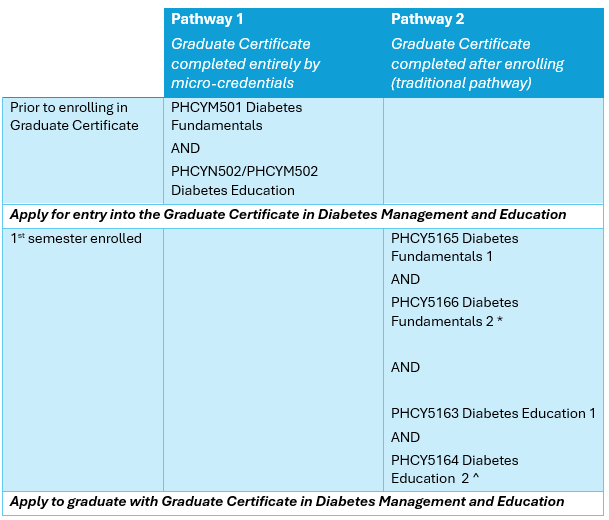
We believe in flexibility at the School of Health and Clinical Sciences at The University of Western Australia. Our Graduate Certificate has been designed to be completed either via microcredentials (PHCYM501 Diabetes Fundamentals and PHCYN502 Diabetes Education) which is pathway 1 or completed via the traditional pathway of enrolling in the Graduate Certificate and then completing the four units. Both pathways have exactly the same expectations, exactly the same assessments and exactly the same content. The difference is when you apply for entry to the Graduate Certificate and when the delivery period is scheduled.
For Pharmacists who want to do the Doctor of Pharmacy Practice
PHCYN502 provides credit for the two core units (PHCY5163 Diabetes Education 1 and PHCY5164) required to complete the Doctor of Pharmacy Practice. PHCYN502 provides credit towards these two units. In other words, completing this Micro-credential now will start your pathway towards earning the Doctor of Pharmacy Practice.
Industry endorsement
Primary health discipline peak bodies recognise these micro-credentials for professional development.


.jpg?h=108.333&w=601.667&hash=C24627D391F97DB43FC9423B33501D2F)

.jpg?h=394&w=680&hash=C11E18491E5ED66283153861354D06AA)
Registrations are closed
Currently the fee is only $990 inc. GST for eligible domestic participants to undertake both 12pt micro-credentials, PHCYM501 and PHCYN502. Thanks to the Australian Department of Education's Microcredentials Pilot in Higher Education we are able to waive the fee for PHCYN502 for a limited time (limited fee-free places available). Government-funded fee-free enrolments for domestic participants share the same eligibility requirements as the Australian Government’s FEE-HELP program.
All fee-free places are now filled and registrations for these micro-credentials are now closed.
PLEASE NOTE: If you have already registered, processing is under way and you will receive an email from UWA soon.