
UWA PLUS
Einsteinian Science for Primary Teachers: Atoms, Light, Space and Climate - PHYSM411
This micro-credential for primary level educators will cover (a) our modern understanding of atoms, heat, states of matter, and the forces that hold them together; (b) the fact that light is made up of photons and the nature of the electromagnetic spectrum; (c) an introduction to the quantum nature of light and matter; (d) an introduction to the concept of spacetime and that gravity is caused by warped spacetime; and (e) the basic science of our climate and the key drivers of climate change. In addition, mathematical concepts, which form the backbone of these scientific principles, will be introduced in an accessible manner.
This micro-credential will cover Year 3 – 6 curriculum topics. Additional extension material will be provided to further explore the in-depth understanding of gravity, spacetime, and Einstein's relativity.
This micro-credential has been developed following discussions and collaborations through the Einstein-First Project, key stakeholders include: Curtin University; the Australian National University (ANU); the WA Department of Education; the Science Teachers' Association of WA (STAWA); the Association of Independent Schools of WA (AISWA); the Australian Research Council; and the Gravity Discovery Centre.
This micro-credential course was developed with the support of the Australian Government’s Micro-credentials Pilot in Higher Education.
Upon successful completion, you'll receive:
- Three (3) PD Points
- A Certificate of Achievement
- A UWA Plus Professional Development Transcript, listing all successfully completed micro-credentials
- Delivery mode
- This micro-credential will be delivered online, with pre-recorded lectures and scheduled online tutorials and workshops.
- Course dates
- 15 February 2027 - 17 April 2027 [MC-1H]
26 July 2027 - 25 September 2027 [MC-3Q] - Registrations will open in November 2026
- Duration
- 6 weeks
- Effort
- Total efforts: 75 hours
Including: Online Lectures, self study, assessment preparations. - Academic lead
- Professor Li Ju
- Cost
- $600 incl. GST
- Critical information summary
- PHYSM411 Critical Information Summary (PDF, 245KB)
Thanks to the Western Australian Government Department of Energy and Economic Diversification's STEM Engagement Sponsorship, WA-based educators or science communicators (including home schoolers, tutors, etc.) will be subsidised, and will only need to pay a discounted fee of $120 inc. GST. Please select the WA Only option on the registration form to access the discounted fee.
What you'll learn
Explain the physical concepts of atoms and molecules and force
Explain the quantum nature of matter and light (atoms, photons and phonons)
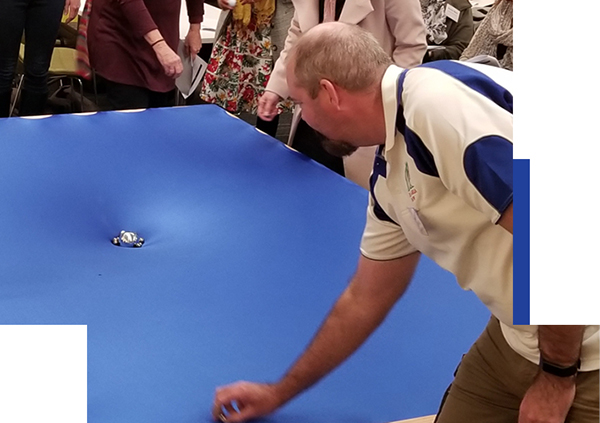
Explain the basic concept of spacetime
Teach the key topics in modern physics at the appropriate school level using simple models and analogies

Why study this course?
This micro-credential will address in-class activities which elucidate Einsteinian concepts and can be fitted into modified elaborations that are consistent with the modern curriculum. This course will equip the participants with the knowledge and skills needed to adopt and develop Einsteinian physics lesson plans for school classrooms.Who should study this course?
This micro-credential is ideal for all primary school teachers and secondary school science and other educators.
Recommended prior knowledge:
No prior study is required but for those wanting a head-start, we recommend the books and research papers listed on
www.einsteinianphysics.com
This micro-credential will consist of online lectures, live tutorials, and training videos. The course will also incorporate fortnightly two-hour interactive online workshop sessions with demonstrators running through the activities live with active audience participation. This course will require a weekly commitment of 3-5 hours per week. All sessions will be recorded if you cannot attend live.
What's next after this course?
This 3 point micro-credential can contribute to future study credit for a Physics Major as part of a Bachelor of Science.
This micro-credential will provide opportunities for school science teachers to upskill to higher level science teaching.
Registrations open in November