
Public Lecture: 'Dear AI Reader: Nonhuman Perspective and Evolutionary Thinking in the Human-Machine Relation'
Event details
Location
- UWA Webb Lecture Theatre, Geography Building
- Map location
Date and time
- Tuesday, 14 July 2026, 6pm - 7pm
Event type
- In-person
Event Fee
- Free
Registration
- Register via the link below
A Public Talk by Chris Danta, Professor of Literature, School of Cybernetics, Australian National University.
Many writers figure machines in evolutionary terms, as living and evolving organisms. The American science fiction writer Philip K. Dick observed in his 1972 speech “The Android and the Human” that in the last decade “our environment, and I mean our man-made world of machines, artificial constructs, computers, electronic systems, interlinking homeostatic components—all this is in fact beginning more and more to possess . . . animation.” Already in the late nineteenth century, English authors Samuel Butler and George Eliot were thinking of machines as living and evolving organisms.
In this talk, Professor Danta will examine how such writers as Dick, Butler, and Eliot rethink what it means to be human by attributing life to their technological environment. He will discuss various speculative rhetorical techniques that writers use to look at the human from the perspective not just of another living organism but also of the surroundings of the human themselves. He will show how writers biologize machines by figuring them as cryptic nonhuman organisms that can merge with and act on behalf of their physical environments. He argues that underlying the techno-anthropologies of writers like Dick, Butler, and Eliot is an environmental understanding of life as the dyadic relation between the organism and its surroundings.
Keynote speaker
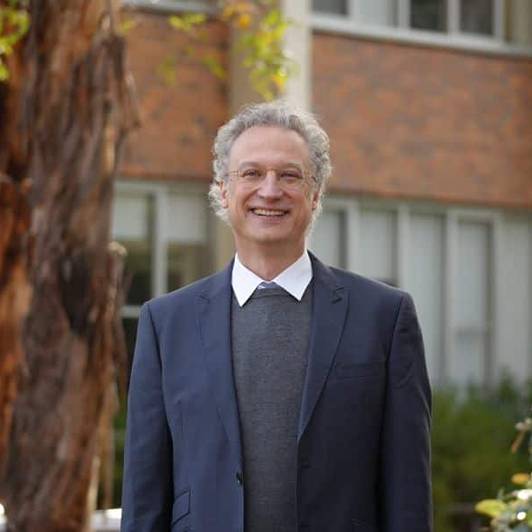
Professor Chris Danta
Chris Danta is professor of literature in the School of Cybernetics at the Australian National University. He is a fellow of the Australian Academy of the Humanities and was recently an Australian Research Council Future Fellow, 2021–25. His research operates at the intersection of literary theory, philosophy, science, and theology. He is currently working on a book titled Future Fables: Literature, Evolution, and Artificial Intelligence.