


Unlocking Wave Energy Converter Hydrodynamics
Uniting world-leading expertise across industry and academia
Funding was secured by UWA MERA in 2023 through the Australia Research Council’s Linkage Project scheme for this collaborative research that unites world-leading expertise across industry and academia to harness a unique combination of numerical, laboratory and field data. This includes operational data from CorPower Ocean’s first full scale wave energy deployment taking place in northern Portugal through HiWave-5 Project.
The Challenge
Low-cost wave energy production is governed by the WEC’s ability to operate at maximum efficiency in the ever-changing ocean environment. Power is force multiplied by velocity, and both need to be optimised for best WEC efficiency. In this project, better ways to predict wave forces on WECs oscillating with optimum (large) velocity will be developed. The ideal WEC operational window is broad- from short choppy wind seas to long swell waves- ensuring power production even as weather patterns and season change. Moreover, real-time control comprising instantaneous fine-tuning of the power take-off delivers increased energy absorption from each passing wave.
Successful design of a WEC thus requires realistic predictions of device motions, power output and the corresponding forces experienced by all parts of the WEC system in varying ocean conditions.
Computational efficiency of numerical models is critical in the following areas:
- Early design stages, where numerous iterations of the WEC geometry need to be tested ion a wide range of wave conditions.
- Deriving estimates for fatigue and (approximate) extreme loading in the detailed design process.
- Real-time control in operating devices, where rapid WEC response calculations are needed based on the approaching waves which will reach the device in the next 30 seconds or so.
Existing models were originally developed to meet the needs of the offshore oil and gas industry for structures where equipment and/or other fixtures were to remain largely motionless to allow for safe operations on deck. On the other hand, WECs are designed to move in response to waves- the large the wave-induced oscillatory motions drive the power take-off which converts mechanical energy into electricity.
Relying on traditional linear wave structure interaction models, which are unable to satisfactorily capture the dynamic effects associated with large body motions, has negative cost implications in terms of compromised performance and higher design safety margins. The challenge for wave energy lies non deriving new modelling tools able to take WEC motions into account with minimal additional computational costs.
Project Approach
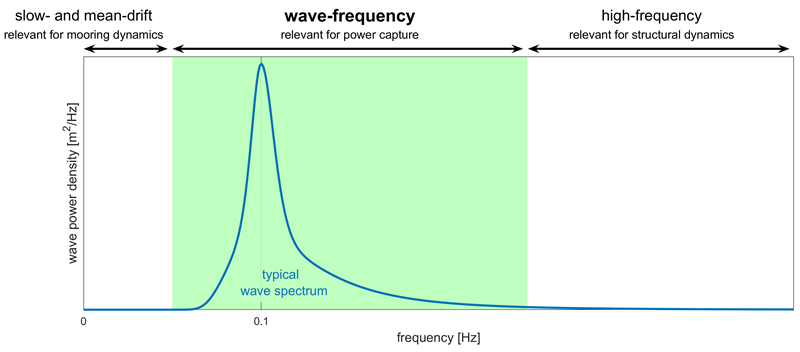
Aim 1: Understand nonlinear WEC dynamics
Planning and execution of high-precision bespoke model-scale wave flume experiments designed to isolate nonlinear dynamic features through careful post-processing and analysis of the data.
Aim 2: Improve accuracy of models and performance of controllers
Identification of dominant nonlinear hydrodynamic effects from the laboratory measurement. Establishing methodology for their simplified representation in efficient particular nonlinear models.
Aim 3: Validate using field data
Simulation of WEC behaviour and evaluation of the nonlinear modelling strategies through a unique comparison with CorPower Ocean (CPO)’s fully instrumented full-scale ocean deployment. Quantification of improvements
Aim 4: Communicate broadly
Knowledge sharing throughout the project with the whole sector via academic and industry conference, webinars, published though pieces, and journal publications.
TIMELINE
Project Start- 2022
Project Completion – 2024
CURRENT STATUS
Current State of the project and findings
The research team has completed a large experimental campaign conducted in a 54 m long wave flume at the University of Western Australia {UWA) Coastal and Offshore Research Lab.
In a simulated ocean environment, wave forces on a fixed and a moving sphere (mimicking CPO's device design) were measured, in 3 blocks of tests:
- diffraction tests with the sphere held fixed ta number of different static immersion levels and subject to short-duration incident wave groups,
- radiation tests in still water with the sphere actuated vertically with its motion consistent with resonant WEC behaviour due to the incident wave conditions in the diffraction tests,
- combined tests with the actuated sphere and the incident wave groups.
Tests with increasing amplitude of the incident waves and of the imposed motions allow identification of nonlinear hydrodynamic effects. Moreover, through varying the timing of the sphere motion relative to the arrival of the incident waves, different nonlinear mechanisms can be isolated. This is a key step in the project, as only the identified dominant nonlinearities shall be accounted for accurately in the numerical models being developed to enable rapid computation.
Our progress so far has been disseminated in the following publications:
1. Phase-manipulation with multiple controlled inputs to enhance investigation of nonlinear hydrodynamic effects.
This paper introduces the novel method developed for isolation of different nonlinear effects which relies on controlled timing/phase of body motions relative to waves. Presented at the International Workshop of Water Waves and Floating Bodies IWWWFB 2023. Download the paper here.
2) Nonlinear hydrodynamic forces on fixed axi-symmetric bodies in incident waves.
This paper presents analysis of the diffraction tests which has identified nonlinear effects in wave-frequency vertical hydrodynamic force .and in the high-frequency horizontal force Presented the International Conference on Ocean, Offshore and Arctic Engineering OMAE2023 . Download the paper here.
3) Nonlinear hydrodynamics of a heaving sphere in diffraction, radiation, and combined tests.
This paper demonstrates presence of nonlinear hydrodynamic effects in the wave-frequency range in diffraction, radiation and combined tests, which would influence the power generation performance. Presented at the European Wave and Tidal Energy Conference EWTEC 2023. Download the paper here.

Application of results to industry
As previously explained, the UWA research team are developing next-generation numerical models for WEC hydro-mechanical systems using CorPower Ocean’s wave energy demo unit in Portugal as test device. This research project is an outgrowth of a previous collaboration between CPO and UWA.
The CorPower Ocean WEC is of the point-absorber type, which by many experts is seen as the most promising category for the development of industrial-scale harvesting of wave energy. The results from this project may benefit any development into this kind of wave power device, or other devices where large amplitude oscillations of rigid WECs are critical.
As part of the HiWave-5 demonstration project in Portugal, CorPower Ocean deployed their first full-scale device at the end of August 2023. This comes as a result of 10 years of product development, building on more than 40 years of international research on wave energy conversion. CPO explained that this project marks a major push towards commercialization as part of a broader mission to make wave energy an economically viable contributor to renewable energy supply by 2030. Descriptions of CorPower Oceans WEC are included below.

The CorPower Ocean C4 device
The C4 full-scale demonstration device is a heaving surface buoy made to absorb and convert energy from ocean waves. The buoy is connected to the seabed using a tension-leg mooring system. Inside the composite hull a machinery converts the translational mechanical energy into rotation, and then into electricity. "The wave motion is turned into rotation, which is converted into electricity by generators inside the buoy" CorPower Ocean explains on its website.
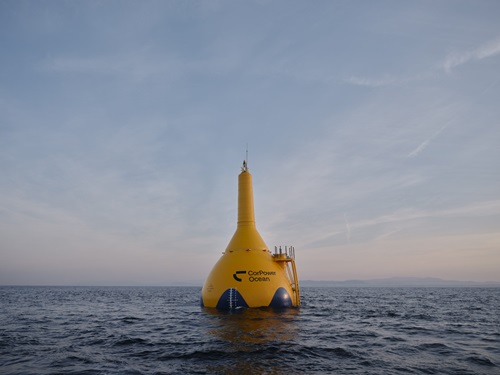

The new numerical formulations resulting from the project will be used by CorPower Ocean to:
- increase the accuracy of mathematical models used in deriving design loads and power output estimates,
- improve the performance of control algorithms, and
- help optimise the system design in future generations of the technology.
The benefits of the new methods developed in the project will be tested by comparison with the currently used models, using data both from simulations and ocean trials.

Marine Energy Research Australia (MERA), a University of Western Australia research centre dedicated to advancement of offshore renewable technologies, providing innovative ocean engineering solutions underpinned by worldclass research.
For detailed research data and information, contact the UWA research team leads:

CorPower Ocean is a leading wave energy technology developer with an advanced wave energy device which can oscillate with optimum (large) amplitudes in a wide range of conditions. Their WEC is serving as the technology basis upon which UWA's research is being conducted.
To learn more about CorPower, its technology and commercial demonstration project, contact:

An industry-led cluster whose aim is to accelerate commercialisation of Australia's ocean energy sector. AOEG is helping extend the reach of this research project to Australia's ocean energy sector.
To learn more about how AOEG is driving collaborative innovation in the ocean energy sector, nationally and internationally, contact: