


Our Reconciliation Journey
First Nations Reconciliation has been at the heart of our school since its inception in 2002. From humble beginnings in Kalgoorlie, the school has been shaped in meaningful ways by First Nations staff, students, community members and allies over the years since. RCSWA teaches Aboriginal health as a core part of the curriculum and works with Aboriginal community-controlled health services in a clinical and research capacity.
By aligning new and existing activities to a framework of Relationships, Respect, Opportunities and Governance, we aim to build relationships with Elders and cultural custodians, enrich our curriculum, and help improve understanding of First Nations cultures, histories and knowledge.
Latest News

Healthy and strong communities
Aurora Abraham has joined the Rural Clinical School of WA in the newly created role of Indigenous Cultural Engagement Officer.

Cultural Guidance and Advocacy
RCSWA Broome Medical Coordinator Dr Nathan Luies has been appointed the school's new Sub-Dean for Aboriginal and Torres Strait Islander Students.

Stepping Up For Reconciliation
RCSWA staff and students have formalised their ongoing commitment to closing the gap with the launch of a Reconciliation Action Plan.

Tooth Fairies Go Bush
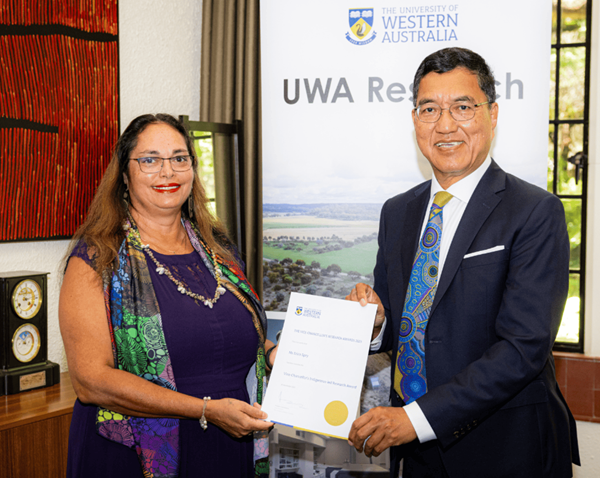
With her new UWA Honorary Doctorate under her wing, Annette Stokes AM is flying back to WA’s Goldfields with a new research goal in her sights.
Advocating For Change
Bardi Jawi woman Erica ‘Roobaanjarn’ Spry has dedicated her career to improving the lives of Aboriginal people in WA’s remote Kimberley region and beyond.

Download our RAP

Reconciliation is an important part of moving forward as individuals, organisations, and as a multicultural nation. It does not blame, but it acknowledges the past and the history and impact of colonisation. It allows truth-telling and the voices of affected families to be heard. Truth-telling is important as it helps non-Indigenous people to understand how the past policies of governments have impacted on Indigenous people. This creates space for both Indigenous and non-Indigenous people to be on the same page, so we can all move forward and improve the social determinants of health in Indigenous people."Matt Lelievre
Nyikina man and RCSWA Research Fellow (pictured left with Erica Spry and Barry Winmar)

About the Artist
.png?h=428&iar=0&w=2560&hash=4AA419601214E79F94AA15305BADB408)
-
How does having a RAP benefit RCSWA students, staff and local community?
The RAP is one aspect of RCSWA’s overall commitment to Aboriginal Reconciliation and helps staff and students to better understand, and engage with, the diverse Aboriginal cultures and communities that exist throughout WA.
The RAP ensures that Aboriginal health teachings remain integrated into the RCSWA curriculum so that students can consider how traditional views of health and healing can be used alongside the medical training they receive. All students participate in North/South Aboriginal health case presentations to highlight the unique disadvantages experienced by rural and remote Aboriginal people in terms of health care access and outcomes.
To better understand the health equity gap and impact of intergenerational trauma, students are immersed in Aboriginal culture, language and truth-telling wherever possible. Several sites coordinate with local Aboriginal Medical Services (AMS) providers to offer training placements to students to gain more experience with Aboriginal patients. Aboriginal Liaison Officers across the WA Country Health Service network also deliver customised cultural training to RCSWA students in the hospital context.
New students begin their academic year together in Perth with a Welcome to Country ceremony by a Noongar leader and are invited to learn more about local cultural heritage from Traditional Custodians when on their respective Countries.
-
How does the RAP support RCSWA rural health research?
Supporting rural health research is an important part of the RCSWA mission to ensure equitable access to high quality, culturally appropriate healthcare for rural and remote Western Australians. Our research is focused on health issues that are relevant to rural and remote locations, especially on questions that cannot be readily explored in an urban context.
Our RAP profiles many of the Aboriginal Community Controlled Health Organisations that we engage with across WA’s diverse rural and Aboriginal communities. We talk about the health issues that they feel are most important, translate findings back into best care, and build a rurally based, broadly skilled health researcher workforce with their support.
For example, consultation with key Aboriginal people, senior management and researchers at the Kimberley Aboriginal Medical Services (KAMS) has led to the development of a RCSWA/KAMS model of Aboriginal health research. By embedding research into existing health services and including Aboriginal people, health service providers, administrators and policy makers as core members of the research team, RCSWA has been able to develop approaches that improve health services for Aboriginal people. This also helps ensure that the process, interpretation, dissemination and implementation of results are culturally safe.
-
Why is a Welcome to Country important?
Protocols for welcoming visitors to Country have always been a part of First Nations cultures. Boundaries were clear and crossing into another group’s Country required permission to enter. When permission was granted, the hosting group would welcome the visitors by offering them safe passage and spiritual protection during their journey. Visitors had to respect the protocols and rules of the Traditional Owners while on their Country.
Today, a Welcome to Country is delivered by a Traditional Owner, or Cultural Custodian who have been given permission from a Traditional Owner to welcome visitors to their Country. The essential elements of the ceremony remain - welcoming visitors and instilling respect for Country.
-
What are some significant cultural events and dates to remember?13 February – Anniversary of the National Apology
21 March – National Close the Gap Day
5 April – Anniversary of the Bringing Them Home Report
26 May – National Sorry Day
27 May – Anniversary of the 1967 Referendum
27 May to 3 June – National Reconciliation Week
7-14 July – NAIDOC Week
4 August – National Aboriginal and Torres Strait Islander Children’s Day
9 August – International Day of the World’s Indigenous People
13 September – Anniversary of the UN Declaration on the Rights of Indigenous People