
Our projects
Following are some current research projects funded by national and international research programs and industry-based organisations.
Water in a changing climate

-
Why is redevelopment hot Measuring cumulative heat in Australian cities
This project aims to understand the impact of urban redevelopment on heat exposure within Australian cities. Using multitemporal high resolution maps of Australian cities provided by Nearmap AI data, cases of urban (re)development will be detected and the warming signal assoicated with these changes in the built environment will be identified.
Funding provided by Australian Research Council.
Project dates: Commenced early 2023, due for completion in 2026.
-
Ripple Effect
The Ripple Effect is a national, grower-led project designed to improve water security, biodiversity, and climate resilience for Australian farmers.
The project will guide growers towards multifunction water infrastructure that enhances and provides future biodiversity and carbon market opportunities while enhancing water security and quality.Led by GGA, the project consortium includes the University of Western Australia, the Australian National University, the University of Adelaide, the University of Southern Queensland, and Blue Carbon Lab (RMIT).
Funding provided by a grant from the Australian Government’s Natural Heritage Trust Climate-Smart Agriculture program.
Project dates: Commenced early 2025, due for completion in 2028.
Resilient landscapes

-
Recharge in a changing climate project
The Recharge in a Changing Climate (RiCC) project is establishing seven monitoring sites on the Swan Coastal Plain to focus on understanding biogeophysical processes affecting the fluxes of water that recharge our aquifers. The project is providing multiseasonal recharge estimates that characterise heterogeneity at plot and larger scales using hydrogephysics and remote sensing.
Funding provided by the Department of Water and Environmental Regulation.
Project dates: Commenced late 2023, due for completion in 2026.
-
Agrivoltaics Integrating Profitable Agricultural Production and Renewable Energy Generation
This project will evaluate the impacts of solar panels on microclimatic conditions in Australian farming systems, identify optimal agrivoltaic configurations for horticulture, viticulture, and pastures, and perform techno-economic-environmental modelling to co-optimise food production, energy generation, and emissions reduction. It will also conduct benefit-cost analyses across Australian regions and develop education and outreach materials to support adoption
Zero Net Emissions Agriculture (ZNE-Ag) CRC is funded by the Australian Government through the Cooperative Research Centres (CRC) Program and the contribution of Partners.
-
Heavy Metal Tooth Fairy
The Heavy Metal Tooth Fairy Project sub-project is aiming to identify childhood exposure to heavy metals in regional and remote Indigenous WA communities by using geochemical analysis of deciduous ‘baby’ teeth.
The Heavy Metal Tooth Fairies is supported by the Stan Perron Charitable Foundation, the Minara Community Foundation, UWA, and the Rural Clinical School of WA.
Project page: https://originsproject.thekids.org.au/sub-projects/oral-health/the-heavy-metal-tooth-fairy-project/ -
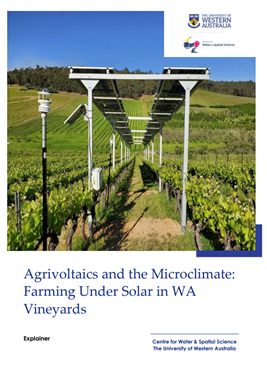
Zero Net Emissions Agriculture CRC Project 4020 Agrivoltaics
Project 4020 Agrivoltaics: Integrating Profitable Agricultural Production and Renewable Energy Generation
This project is being completed as part of Program 4: Delivering Value from Net Zero
This project will evaluate the impacts of solar panels on microclimatic conditions in Australian farming systems, identify optimal agrivoltaic configurations for horticulture, viticulture, and pastures, and perform techno-economic-environmental modelling to co-optimise food production, energy generation, and emissions reduction. It will also conduct benefit-cost analyses across Australian regions and develop education and outreach materials to support adoption
Resource:
This explainer draws on the scientific perspectives shared by The University of Western Australia researcher Dr Caitlin Moore during a public webinar on the agrivoltaics demonstration at Plume Estate.
Agrivoltaics and the Microclimate: Farming Under Solar (PDF 1.79 MB)
Catchment to coasts

-
Pilbara intertidal mapping project
This project will assess and map a regional scale cyanobacterial mat extent. In the Exmouth Gulf and Pilbara coast, salt flats occur on the landward edge of intertidal zone, often bordered seaward by fringing mangroves and landward by dunes. Salt flats cover 1026 square kilometres in the Exmouth Gulf, an area over six times greater than mangroves here. Globally, these environments are understudied, yet are of increasing interest due to the salt minerals they contain.
Funding is provided by The Western Australian Marine Science Institution (WAMSI).
Project dates: Commenced late 2022, due for completion in 2025.
Data-driven discovery and spatial analytics

-
TERN WA Project
The project's three monitoring sites (Gingin, Boyagin and Great Western Woodlands) cover a biodiverse ecological and climate gradient. New equipment at these sites will enable improved characterisation of water cycle processes across these landscapes focusing on linking ecosystem stress to drivers such as temperature and water stress.
Funding is provided by NCRIS Terrestrial Ecosystem Research Network (TERN) and WA State Government co-investment from WA Department of Jobs, Tourism, Science & Innovation (JTSI).
Project dates: Commenced late 2023, due for completion in 2028.
-
The Australian CZO network OzCZO project
This project consists of multiple Critical Zone Observatories (CZOs) across the Australian continent that are designed for advanced studies of biogeochemical processes and elemental/isotope cycles within near-surface reservoirs, including vegetation, soils, vadose zone and groundwater. Partnering with national research infrastructure projects TERN and AuScope, OzCZO fills crucial gaps in environmental monitoring, particularly regarding soil dynamics, root zones, and integrated processes within the critical zone.
Funding is part of the Australian Research Council’s Large Infrastructure, Equipment and Facilities scheme (ARC LIEF)— provided by the Australian Government.
Project dates: Commenced early 2021, due for completion in 2025.
Research Teaching Nexus

-
Micro credentials
Focused on skills that are in high demand, these courses are short and flexible. Update, upskill or re-skill – complete a one-off micro-credential or stack them up and convert into credit towards an undergraduate or postgraduate qualification – the choice is yours.
LEARN MORE link to UWA Plus website