
Researchers from The University of Western Australia have exposed major vulnerabilities in current crop protection strategies.
The study, published in the journal Pathogens, investigated the impact of virus-fungus pathogen coinfection in the oilseed crop canola.
It found that prior viral infections with turnip mosaic virus in canola host plants triggered a breakdown in resistance to blackleg disease, caused by the most damaging fungal pathogen of canola (Leptosphaeria maculans).
The project, undertaken by UWA PhD candidate Nuraizat Abidin from Brunei, tested foliage of virus-infected canola plants with fungal single dominant gene resistance or fungal polygenic resistance, using fungal spore spray-inoculation under closely simulated field conditions.
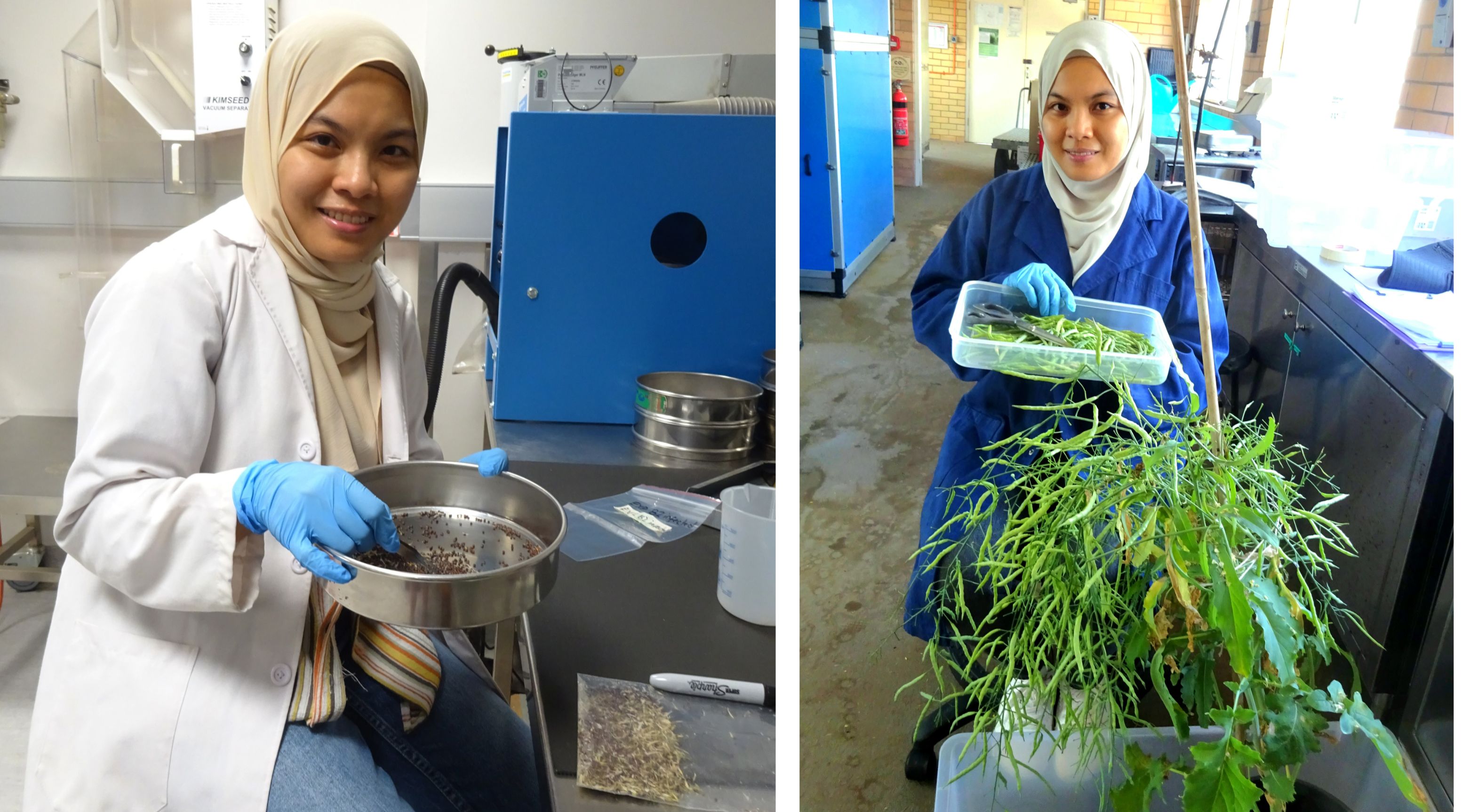 Image: Nuraizat Abidin sieving seeds and inspecting plants in the glasshouse.
Polygenic resistance describes disease resistance in plants that is controlled by multiple genes rather than just a single gene.
For a canola variety carrying polygenic resistance, prior viral infection with a non-resistance breaking fungal strain was found to cause this resistance to break down completely – moving from zero fungal disease to very severe fungal disease symptoms.
The resistance breakdown in a variety with single gene resistance was also considerable.
Across different combinations of resistance breaking and non-resistance breaking fungal strains, the resistance breakdown caused by virus-fungus coinfection increased necrotic fungal disease symptoms by up to 7.4-fold in a cultivar with single dominant gene resistance, and 3.7-fold in a cultivar with polygenic resistance.
Ms Abidin said previous viral infection acted as a 'saboteur', causing fungal host-resistance breakdown in coinfected plants.
"This research addresses an important and relatively underexplored aspect of plant pathology: viral–fungal pathogen interactions and their effects on host resistance durability when both pathogens infect the same plants in the field."
Nuraizat Abidin
The study demonstrated that evaluating host plant resistance against a single pathogen in isolation can greatly overestimate crop resilience, given that viral and fungal co-infections frequently occur naturally in the field.
Ms Abidin said the findings reinforced the critical need for agricultural scientists and plant breeders to account for virus-fungus coinfection scenarios to prevent severe yield losses and develop more resilient crop cultivars.
"This applies not only to the greater economic impacts upon yield and quality losses likely to arise, but also the need to breed new cultivated plant cultivars with effective host resistance to both pathogens in frequently occurring coinfection circumstances," she said.
Ms Abidin’s PhD was supervised by UWA’s Professor Martin Barbetti, Adjunct Professor Roger Jones and Dr Ming Pei You, and co-funded by the Brunei Government and UWA University Postgraduate Award.
Media references
Rosanna Candler (Communications Officer, The UWA Institute of Agriculture) +61 08 6488 1650
Professor Martin Barbetti (Fungus disease Plant Pathologist) +61 08 6488 3924
Adjunct Professor Roger Jones (Virus disease Plant Pathologist) +61 08 6488 1233