Decades of mining and industrial use have left Western Australia with some of the highest rates of the asbestos-related disease mesothelioma in the world.
Ongoing exposure around the globe means the aggressive cancer, caused by asbestos exposure, remains a serious international challenge.
At The University of Western Australia, researchers are working to change this story.
In partnership with the National Centre for Asbestos-Related Diseases (NCARD) and the Institute for Respiratory Health, UWA researchers are advancing earlier detection, new treatments and improved care – driving meaningful progress against a disease long considered difficult to treat.
For Anne-Louise Willoughby, supporting mesothelioma research is a way of honouring her late husband Tim – ensuring his lifelong commitment to community, young people and medical research continues to make a difference.
Through a generous endowment, Anne-Louise created the Tim Willoughby Research Grant to provide perpetual support for early and mid-career researchers at NCARD, while carrying Tim’s vision forward for generations to come.
“Tim believed strongly in creating opportunities for others,” Anne-Louise said. “This is a way of continuing that belief and keeping his memory alive through meaningful impact.”
Originally from South Australia, Tim Willoughby left an indelible mark on WA. A dual Olympian, he served as president of the Western Australian Olympic Council, was a successful WA Kings Cup rowing coach and an America’s Cup yachtsman.
As a dedicated mentor much of Tim’s life centred on supporting young people and giving back through the skills he had developed as both an athlete and businessman.
Behind the scenes, he was also a passionate advocate for medical research. He worked closely with Harry Perkins in the early development of the Western Australian Institute for Medical Research, now the Harry Perkins Institute of Medical Research, and with Professor Bruce Robinson to galvanise support for the establishment of NCARD.
Tim’s quiet determination and advocacy helped build what is now a world-leading centre dedicated to preventing, monitoring, treating and ultimately curing asbestos-related diseases.
The grant established in his name reflects his belief in nurturing emerging talent – providing researchers with the resources to collaborate, travel and take the next steps in their work.
Anne-Louise’s own connection to UWA is long-standing and deeply rooted. Her parents were graduates – her father founded the UWA Soccer Club in 1949, which continues to thrive today, and her mother was a researcher in anthropology.
After a career in journalism that began with a cadetship, Anne-Louise returned to UWA. She completed a Bachelor of Arts with Honours and a PhD in biography and later taught in the Creative Writing program. All four of her children are also UWA graduates, making the University central to the family’s story.
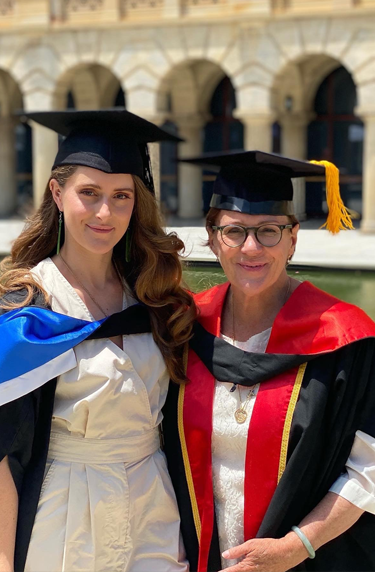
Image: Dr Anne-Louise Willoughby (right) as UWA staff attending her daughter Nina Willoughby’s graduation ceremony in 2021
“I appreciate the value this education has delivered to all of us,” Anne-Louise said. “With Tim’s connection to the work being done in medical research, supporting this grant felt like a natural continuation of our shared values that would continue his legacy.”
The inaugural 2025 recipient of the Tim Willoughby Research Grant is PhD candidate Callum Flanagan, whose own path to cancer research was shaped by personal experience.
Inspired by his father’s diagnosis with metastatic cancer – and his eventual recovery through targeted therapy – Callum is driven to improve outcomes for others.
“Being a scientist has been my dream since I was a kid,” Callum said. “More than anything, I hope my work will mean more people are able to survive cancer.”
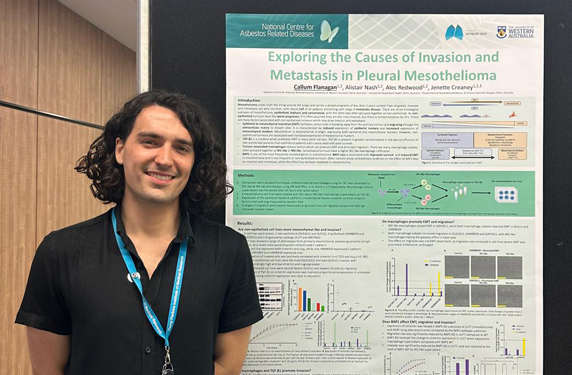
Image: Callum Flanagan
Callum’s research focuses on understanding why mesothelioma spreads rapidly through the body, particularly the role of mutations in the BAP1 gene commonly found in this cancer.
Supported by the grant, Callum has conducted a pilot study using a cutting-edge technique known as CUT&RUN to examine how the mutations influence other genes involved in cancer progression. The results have been promising and enabled a larger study that is now underway.
“I’m incredibly grateful to Anne-Louise and the Willoughby family for supporting my research,” Callum said. “This has become a major part of my project and significantly strengthened my future career prospects.”
Looking ahead, the impact of this work reaches far beyond one disease. Advances in mesothelioma research – particularly in multi-modal treatments such as immunotherapy – are contributing to broader progress across cancer care.
For Anne-Louise, the endowment is not only an investment in science, but a living tribute. Knowing that the endowment can contribute to fostering collaboration in finding new solutions is something she knows Tim would endorse.
As UWA and NCARD continue to lead in this field, that legacy remains a powerful reminder of how one person’s passion can shape the future.