
Hidden among the towering forests, heathlands and granite peaks of Western Australia’s southwest lies one of Australia’s most remarkable ecosystems. These are the Empodisma peatlands, ancient wetlands that have quietly accumulated carbon, retained and filtered water and supported unique wildlife for thousands of years.
Although Empodisma peatlands occur in relatively small and scattered pockets of the southwest bioregion, they can store vast amounts of carbon when they remain in good condition. They also provide habitat for species found nowhere else, such as the endemic sunset frog, discovered in the 1990s. Today, researchers are using genetics, environmental DNA (eDNA) and large-scale biodiversity monitoring to better understand and protect these unique environments.
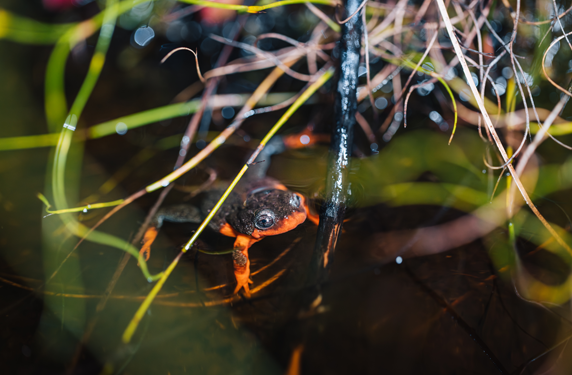
Image by Holly Winkle: sunset frog
The plant that builds these wetlands
At the heart of southwest peatlands is a bright green sedge-like plant called Empodisma gracillimum, commonly known as tanglefoot. Despite its modest stature, it is an ecosystem engineer.
Over centuries, Empodisma forms dense underground networks of roots and rhizomes. In waterlogged conditions, dead plant material decomposes very slowly because oxygen levels are low. As a result, organic matter accumulates faster than it breaks down, gradually forming peat deposits that can reach several metres in thickness. The plant’s extensive root systems act like giant sponges, holding water and organic matter and creating the stable conditions needed for continued peat formation.
Small ecosystems with global significance
Peatlands cover only a small fraction of the Earth’s surface, yet they are among the planet’s most important ecosystems. Globally, they store more carbon than all the world’s forests combined, making them critical allies in climate regulation.
Western Australia’s southwest peatlands provide similar benefits on a regional scale, but are increasingly threatened. This status became official in 2023 when Empodisma peatlands were listed as an ‘Endangered’ Threatened Ecological Community under Australia’s Environment Protection and Biodiversity Conservation Act. Declining rainfall, groundwater extraction, altered fire regimes, invasive species and plant diseases all threaten their long-term survival. Critically, when peat dries out, it can decompose and becomes highly flammable, releasing precious stores of carbon back into the atmosphere.
A refuge for unique life
The isolation and stability of southwest peatlands have allowed unique species to evolve over millions of years, many of which are relics of ancient Gondwanan ecosystems.
The Albany pitcher plant: a southwest botanical predator
Among the most remarkable residents of southwest peatlands is the Albany pitcher plant (Cephalotus follicularis), a cryptic carnivorous species found only in coastal regions of southwestern Australia. Its specialised pitcher-shaped leaves trap insects, allowing it to thrive in the nutrient-poor conditions of peat soils.
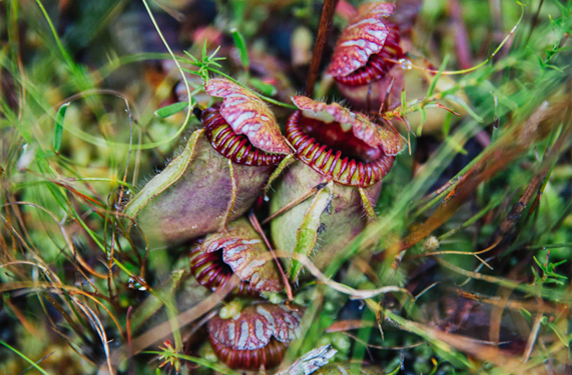
Image by Holly Winkle: Albany pitcher plant
The ant-mimicking fly: incubated by its predator
The pitcher plant also supports one of nature's most extraordinary partnerships. The ant-mimicking fly (Badisis ambulans) lays its eggs inside the plant's pitchers, where its larvae develop by feeding on trapped insects and organic matter. Nowhere else on Earth can the species complete its life cycle, highlighting the intricate ecological relationships hidden within these wetlands.
The sunset frog: a jewel of the peatlands
The sunset frog (Spicospina flammocaerulea) is another peatland icon, with a lineage tracing back around 30 million years, making it one of Australia’s oldest frog species. This striking species is named for the vivid orange and blue colours of its undersurface. Found only near Walpole and Nornalup, it is one of Australia's most geographically restricted amphibians. Threatened by drying conditions, disease, more frequent fire and habitat disturbance, sunset frogs are a powerful symbol of the importance of protecting southwest peatlands and the unique biodiversity they support.
Genomics, eDNA and the future of peatland conservation
Modern DNA technologies are transforming conservation science and revealing hidden dimensions of peatland biodiversity.
Working with partners, including Biologic Environmental, researchers are using genomic and environmental DNA approaches to study Empodisma, sunset frogs, pitcher plants, peatland invertebrates and the microbial communities that live in the peat itself. Environmental DNA, or eDNA, allows species to be detected from tiny traces of genetic material left behind in soil, water or vegetation, providing a powerful non-invasive monitoring tool that is ideal for detecting threatened and elusive species.
These techniques are helping scientists reconstruct the evolutionary history of key peatland species, measure genetic diversity, understand connectivity between isolated populations and identify populations at greatest risk.
Protecting this living laboratory
The PEAT Southwest initiative is revealing that peatlands are far more than isolated bogs. Through BioBlitz events, biodiversity surveys, predictive mapping, hydrological studies, radio-carbon dating, microbiome studies and ecological research, scientists, Traditional Custodians, community volunteers and land management organisations are building an unprecedented understanding of these ecosystems.
The knowledge gained will help guide practical conservation actions, including feral animal control, disease management, opportunities for restoration and applying fire to an increasingly flammable landscape.
While the threats facing southwest peatlands are significant, there is reason for optimism. Through collaboration between researchers, Noongar elders, government agencies, consultants, and land stewardship organisations, new knowledge is informing efforts to support these unique environments for future generations.
From the carnivorous Albany pitcher plant and the highly specialised ant-mimicking fly to sunset frogs calling from tiny breeding pools, these species remind us that some of the world’s most remarkable biodiversity survives in places few people ever see.
Protecting Empodisma peatlands is about far more than conserving individual species. It is about safeguarding carbon-rich peat soils, maintaining wetland functions, supporting resilient ecological communities, and recognising the cultural values, knowledge and continuing relationships connected with Country.
PEAT Southwest is supported by The Ian Potter Foundation and Lotterywest. The project is co-led by The University of Western Australia and Edith Cowan University, guided by Noongar Elders, and delivered in collaboration with the Walpole-Nornalup National Parks Association, Undalup Association, the Western Australian Museum, Biologic Environmental, the Department of Biodiversity, Conservation and Attractions, South Coast National Resource Management and South West NRM.