
Navigating modern agricultural challenges requires more than experience, it demands data, insight, and an understanding of human decision-making. At the UWA School of Agriculture and Environment, Dr Sarah Whitnall and Dr Curtis Rollins are combining these elements to explore how farmers respond to climate change, market pressures, and environmental policies.
For Dr Whitnall, Lecturer in Agricultural and Resource Economics at UWA School of Agriculture and Environment, understanding climate impacts is central. “Prior work on the effect of weather and climate change on agricultural production mostly focuses on staple crop yields,” she explains. “I explore new channels, including product quality and postharvest losses, which are critical for determining prices and farm profitability.”
Dr Whitnall's work extends beyond crops to the people who produce them. “Farmwork is physically demanding and outdoors,” she says. “Agricultural workers are among the most vulnerable to heat stress, and climate change is fusing their physical and financial wellbeing with that of farm managers.” By combining high-resolution farm-level data with applied econometrics, her work wants to translate complex trends into actionable strategies for the sector.
While Dr Whitnall focuses on climate and data, Dr Curtis Rollins, Lecturer and Deputy Director of Training at the Centre for Environmental Economics and Policy, examines the human side of agriculture. “I’m exploring how the public, experts, and landowners perceive ambitious new biodiversity goals and policies,” he says. “The challenge is finding the right balance between improving environmental outcomes, maintaining food production, and supporting the wellbeing of farmers and rural communities.”
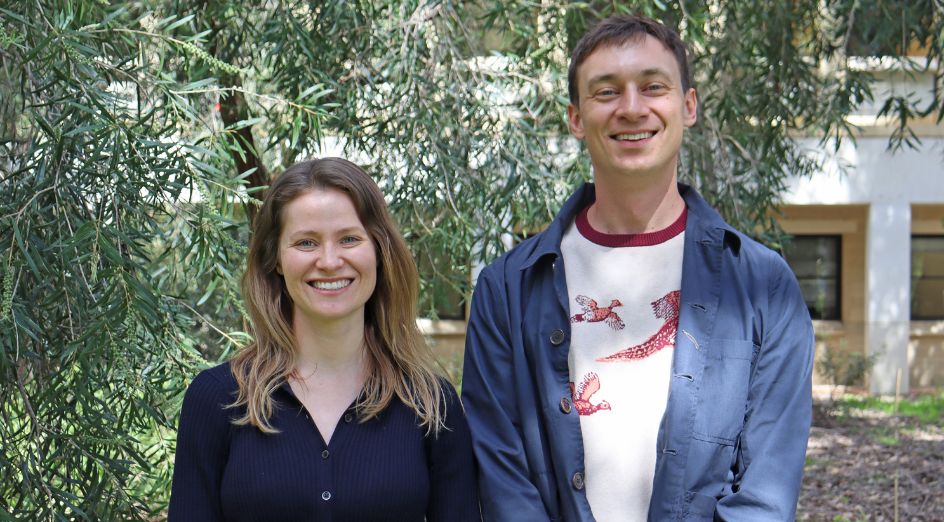 Image: Dr Whitnall and Dr Rollins at UWA Crawley Campus
Dr Rollins integrates psychology and sociology into economic models to understand decision-making. “Interdisciplinary collaboration is essential,” he notes. “I work with ecologists, agricultural scientists, sociologists, psychologists, and farmers themselves. Together, these perspectives help create richer, more accurate representations of how people make decisions around sustainability,” he explains.
Dr Whitnall and Dr Rollins exemplify the interdisciplinary strength driving research at UWA’s School of Agriculture and Environment. Their complementary work, rooted in data yet responsive to human behaviour, strengthens a vision of agricultural economics that connects evidence with empathy. By reimagining the field not merely as the study of markets and yields, but as an exploration of resilience, they are helping UWA build a foundation for more adaptive, inclusive, and forward-thinking responses to the challenges facing agriculture and rural communities worldwide.
Media references
Dr Sarah Whitnall, UWA School of Agriculture and Environment, UWA Centre for Agricultural Economics and Development
Dr Curtis Rollins, UWA School of Agriculture and Environment, UWA Centre for Environmental Economics and Policy
Ana Mendigutxia Balil (Communications Officer, The UWA Institute of Agriculture) +61 08 6488 1650