
Results from four years of plant breeding led by The University of Western Australia will soon deliver climate resilient, nutrient-rich and rapid-cooking beans for the benefit of African women and children.
The findings were recently published in the Springer-Nature plant breeding journal Theoretical and Applied Genetics.
Led by researchers from The UWA Institute of Agriculture together with African colleagues in The Alliance of Bioversity and CIAT (Alliance-CIAT) through the Pan-Africa Bean Research Alliance (PABRA), the team achieved rapid genetic gain for cooking time and improved iron and zinc content and other seed quality traits for the common bean Phaseolus vulgaris.
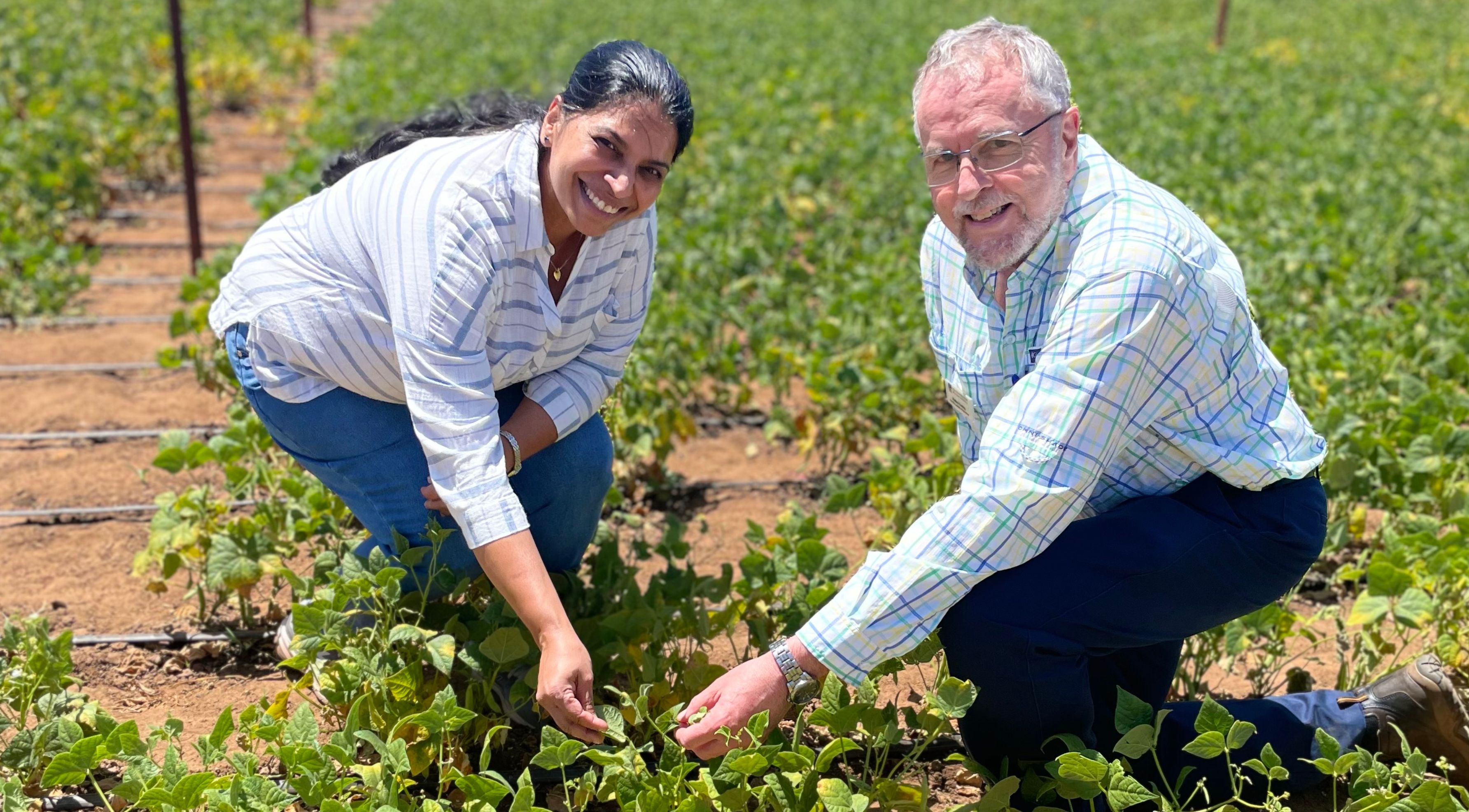 Image: UWA research associate Dr Renu Saradadevi. and Professor Wallace Cowling.
The project, funded by the Australian Centre for International Agricultural Research (ACIAR), will enable PABRA project partners in Rwanda, Burundi, Uganda, Kenya, Tanzania and Ethiopia to give farmers access to new rapid-cooking and nutritious bean varieties.
The UWA team included project leader Institute Associate Director Professor Wallace Cowling, research associate Dr Renu Saradadevi, Dr Felipe Castro-Urrea and Institute Director Professor Kadambot Siddique.
Dr Saradadevi said they developed a new breeding and analysis method BRÍO and applied it to African bean breeding.
“Our genomic selection has rapidly reduced the average cooking time by 11 per cent every year, for the past four years,” she said.
“This occurred despite the low genomic heritability of cooking time (0.16), meaning that environmental factors in the greenhouse and laboratory were driving most of the variation.”
Professor Cowling said the value of collaboration and team effort across several institutes in Africa and Australia could not be overstated.
“University of New England Associate Professor Li Li helped us transfer the method of single-step genomic selection from animals to cooking time in beans,” he said.
"Soon we will apply the method to grain yield data across six East African partner countries."
Professor Wallace Cowling
The Bean Breeding Program at the Alliance-CIAT in Uganda leads the project in Africa and included Dr Clare Mukankusi, Dr Winnyfred Amongi and Alan Male who implemented enhanced selection techniques in the field, greenhouse and laboratory.
Dr Amongi sent seeds to partners in six countries in East Africa, who field-tested the material for grain yield and disease resistance and Mr Male then tested each plant for genomic molecular markers.
 Image: A demonstration of preparing the beans at the Kenya Agricultural and Livestock Research Organization.
PABRA Director and Alliance-CIAT Bean Programme leader Jean-Claude Rubyogo said healthy African families cooked and consumed beans every day.
“This ACIAR project is a gamechanger for African bean farmers, processors and consumers,” Mr Rubyuogo said.
“Beans are often cooked at home over open wood fires, so less cooking time means less smoke inhalation, less water consumption and more time to generate income.
“In addition, bean processors are excited about the prospect of rapid cooking beans which will improve profitability and reduce prices of processed beans for the African market.”
Eric Huttner, who was ACIAR Program Manager Crops during the project phase, said it was rewarding to see strong responses to selection and improvements in methods of testing in the laboratory and field.
“The team members have strong reach into industry, farming and government in Africa, and PABRA will ensure adoption of the new rapid cooking bean varieties across Africa,” Dr Huttner said.
Media references
Rosanna Candler (Communications Officer, The UWA Institute of Agriculture) +61 08 6488 1650
Professor Wallace Cowling (Associate Director, The UWA Institute of Agriculture) 0429 207 577