
Biomedical scientists have developed a new nanoscale imaging technique that allows researchers to directly see how bone-forming cells use nutrients and build bone inside the body.
Led by Dr Kai Chen , from The University of Western Australia’s School of Biomedical Sciences, and Associate Professor Haibo Jiang, from The University of Hong Kong’s Department of Chemistry, the study provides new insight into how bone architecture develops and is maintained.
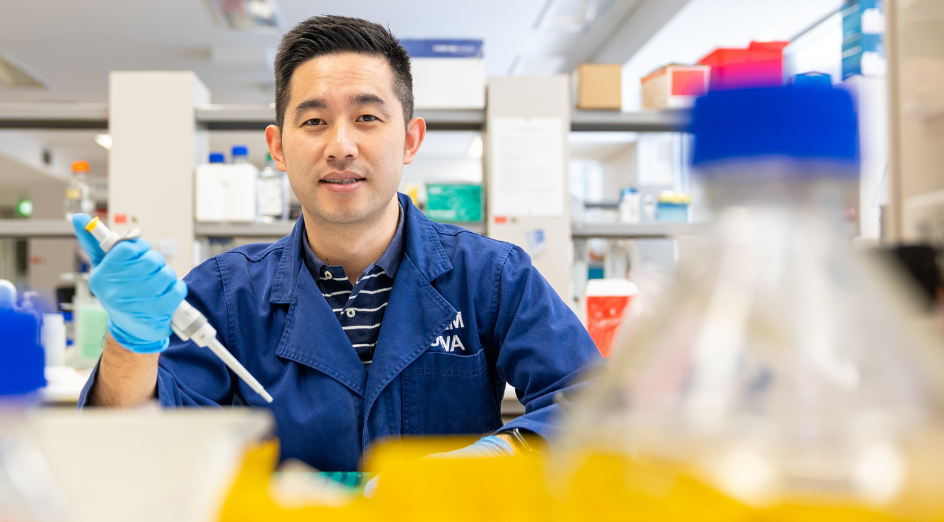 Image: Dr Kai Chen.
Published in Proceedings of the National Academy of Science, the study combined stable isotope tracing, electron microscopy and NanoSIMS imaging to follow nutrient use from individual cell organelles through to newly formed bone cells at nanometre resolution.
“Our results showed osteoblasts, bone-forming cells, work much faster in the body than previously thought,” Dr Chen said.
“We were able to visualise bone formation over time and identify how new bone produced by osteoblasts is spatially organised.”
The findings revealed relationships between newly deposited bone (produced by osteoblasts), pre-existing bone structures and the microscopic processes extending from osteocytes, the mature bone cells.
Researchers discovered ongoing activity in cells embedded deep within bone. Mature bone cells showed highly localised amino-acid incorporation and turnover in the newly deposited bone cells immediately surrounding them, while osteoclasts (cells that break down bone tissue) were found to be associated not only with old bone but also with newly formed and mixed-age bone cells.
“This finding highlights how dynamic bone formation and resorption are at the microscopic level,” Associate Professor Jiang said.
“Importantly, we could directly visualise how these processes deteriorate with ageing to provide a new way of understanding the cellular and metabolic changes underlying age-related loss of bone-forming capacity.
“This could ultimately help researchers investigate why bone formation becomes impaired in ageing, osteoporosis and other skeletal diseases, and how treatments might restore these processes.”