
In Kalgoorlie’s busy hospital and GP clinics, a quiet shift is underway. International medical graduates (IMGs), who make up a vital part of the regional health workforce, are strengthening not only their clinical communication but also their confidence in connecting with patients, colleagues and the wider community.
This transformation is being driven by the Communication Skills for Medical Professionals program - a collaborative initiative of the Rural Clinical School of WA (RCSWA) Regional Training Hubs, University of Tasmania International School and the WA Country Health Service (WACHS) Medical Education Unit.
Why Regional Training Hubs?
Funded by the Commonwealth, the Regional Training Hubs network is tasked with building and sustaining a skilled medical workforce in regional Australia. Its mandate is to expand the rural medical training pipeline to enable more doctors to complete their entire journey - from student to specialist in rural Australia. Communication Skills for Medical Professionals fits squarely within that mission, ensuring IMGs, who are often the backbone of regional health delivery, receive targeted support to thrive in their new communities.
Overcoming language barriers
Medical knowledge travels well across borders, but communication does not. For IMGs, adapting to Australian workplace culture, idioms, and patient expectations can be as challenging as clinical demands. Recognising this, the program has blended online units with face-to-face workshops in Kalgoorlie, covering practical skills such as ISOBAR handovers, oral delivery skills, culturally respectful consultations and health-related colloquialisms.
The outcomes have been striking. Following a successful pilot in February, a second workshop was delivered in September, in addition to a new program ‘Communication Skills for Medical Supervisors’, developed in response to stakeholder feedback. Together, these initiatives have improved communication, strengthened teamwork, and enhanced collaboration between IMGs, their supervisors and hospital colleagues. Community-based GPs also reported smoother referrals, stronger teamwork and a greater sense of professional rapport.
As program coordinator Toni Hawkins said: “Before, there was hesitancy - now, there’s confidence. They feel more comfortable interacting with colleagues across the health spectrum and building those connections that are so vital in regional health.”
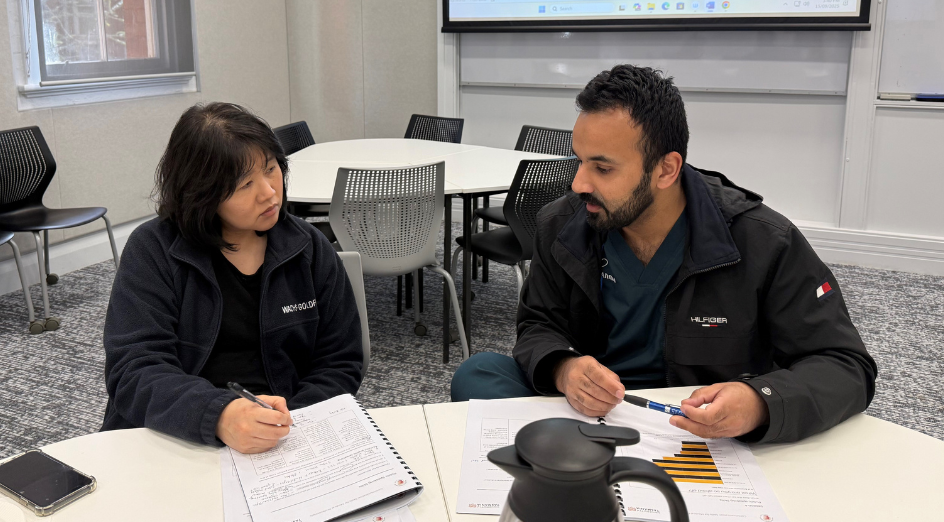
Image: Dr Aliya and Dr Bilal in a communications workshop.
Cultural learning from the heart
One of the most powerful sessions came from Trevor Donaldson, a respected Aboriginal community leader. He created a safe space where IMGs could ask questions - such as how to respectfully address Aboriginal patients when cultural protocols restrict the use of names during mourning. His guidance gave participants practical strategies while deepening their cultural awareness, a crucial part of providing safe care in regional WA.
Looking ahead
Following the success of the Kalgoorlie workshops, discussions are underway to explore expanding the program to other IMG-rich regions such as Bunbury and Geraldton. For Regional Training Hubs, it represents a model of how targeted training can boost retention: when doctors feel supported, they are more likely to stay.
One GP Registrar participant said he really enjoyed the face-to-face sessions and felt more confident as a result.
“I appreciate you coming all the way to Kalgoorlie for the sessions. They have been super helpful for all of us to get more confident with our communication skills, especially in an Aussie way!” he said.
Toni Hawkins summed it up. “This isn’t just about language - it’s about belonging,” she said.
“When IMGs feel equipped to communicate, they feel part of the community. That’s what keeps them here.”
In regional health - words matter - and thanks to this collaboration, more international doctors are finding just the right ones.
Contact [email protected] for more information.
.png)
Image: Dr Sam and Dr David in a communications workshop.